If you tried this recipe I would love to see it!Tag me on Instagram @whatsinthepanblog
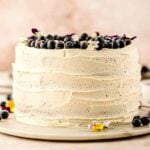
Vanilla Layer Cake From Scratch
A from-scratch vanilla layer cake with a soft, buttery crumb built on a tested formula of creamed butter, buttermilk, and a 3-egg-plus-2-white ratio. Bakes into three sturdy 8-inch layers that stack cleanly under frosting and filling — the base recipe behind every celebration layer cake on this site.
Servings: 12
Ingredients
Dry Ingredients
- 3⅔ cups all-purpose flour, spooned and leveled, 458g
- 2 teaspoons baking powder
- ¾ teaspoon baking soda
- 1 teaspoon fine sea salt
Wet Ingredients
- 1½ cups unsalted butter, softened to room temperature, 340g
- 2 cups granulated sugar, 400g
- 3 large eggs, room temperature
- 2 large egg whites, room temperature
- 1 tablespoon pure vanilla extract
- 1½ cups buttermilk, room temperature, 360ml
Instructions
- Preheat oven to 350°F (175°C). Grease three 8-inch round cake pans and line the bottoms with parchment paper rounds. Set aside.
Mix Dry Ingredients
- In a medium bowl, whisk together the flour, baking powder, baking soda, and salt. Set aside.
Mix Wet Ingredients
- In a large mixing bowl, beat the softened butter and granulated sugar together on medium-high speed for 3 to 5 full minutes, until the mixture turns pale — almost white — and is noticeably light and fluffy. Do not rush this step. Under-creamed butter produces a denser crumb.
- With the mixer on medium, add the whole eggs one at a time, mixing for 20 to 30 seconds after each addition before adding the next. Add the egg whites and mix until fully incorporated. Mix in the vanilla extract.
Alternate dry ingredients and buttermilk
- With the mixer on low, add half the dry ingredients and mix until just combined. Pour in half the buttermilk and mix gently. Add the remaining dry ingredients, then the remaining buttermilk, mixing only until the batter is smooth. Scrape down the sides and bottom of the bowl with a spatula.
Weigh and fill the pans
- Place each prepared pan on a kitchen scale, zero it out, and divide the batter evenly — approximately equal grams per pan. This ensures even baking and level layers. Smooth the tops gently.
Bake
- Bake for 28 to 32 minutes, checking at 26 minutes. The cakes are done when: the tops spring back when lightly pressed, the edges begin to pull away from the sides of the pans, and a toothpick inserted into the center comes out clean or with a few moist crumbs.
Cool
- Let the cakes cool in the pans for 10 to 15 minutes. Run a thin spatula around the edges, then invert onto wire racks. Peel off the parchment immediately. Cool completely — at least 1 to 2 hours — before frosting or assembling.
Nutrition Facts
Vanilla Layer Cake From Scratch
Amount per Serving
Calories
512
% Daily Value*
Fat
26
g
40
%
Saturated Fat
16
g
100
%
Trans Fat
1
g
Polyunsaturated Fat
1
g
Monounsaturated Fat
7
g
Cholesterol
105
mg
35
%
Sodium
323
mg
14
%
Potassium
181
mg
5
%
Carbohydrates
64
g
21
%
Fiber
1
g
4
%
Sugar
35
g
39
%
Protein
7
g
14
%
Vitamin A
819
IU
16
%
Calcium
83
mg
8
%
Iron
2
mg
11
%
* Percent Daily Values are based on a 2000 calorie diet.
Nutritional information is provided as a courtesy only. This information comes from online calculators. Although whatsinthepan.com attempts to provide accurate nutritional information, these figures are only estimates.
Notes
1. Measure flour correctly — this is the most common cause of dry cake.
Spoon flour from the bag into your measuring cup, then level with a flat edge. Do not scoop directly from the bag — scooping compacts the flour and can add up to 30% more than intended. For best results, weigh it: 3⅔ cups = approximately 458 grams.
2. Butter must be genuinely room temperature.
Press a finger into the butter — it should indent easily without leaving grease. Too cold and it won't cream properly. Too soft or melted and the batter will look greasy and curdled. Leave it out for 30 to 45 minutes before starting. 3. Do not shortcut the creaming step.
Three to five minutes is the minimum, not a suggestion. The mixture should look pale, almost white, and visibly fluffy before you add the eggs. This is your leavening foundation — under-cream it and no other step compensates. 4. Room temperature eggs and buttermilk matter.
Cold eggs and buttermilk can cause the batter to curdle slightly and create an uneven crumb. Set them out with the butter 30 to 45 minutes ahead. 5. No buttermilk? Here's the substitute.
Add 1½ tablespoons of white vinegar or fresh lemon juice to a liquid measuring cup. Fill to the 1½ cup line with whole milk. Stir and let sit for 5 minutes until slightly curdled. This mimics the acidity of buttermilk. Note: the cake will be slightly less moist than the buttermilk version, particularly by day two. 6. Weigh the batter — don't eyeball it.
Dividing batter by eye almost always produces uneven layers: one thin, one thick, one that overbakes while the others catch up. Weighing takes 90 seconds and produces level, even layers every time. 7. Don't overbake.
Vanilla cake is unforgiving of overbaking — there's no strong flavor to hide behind. When in doubt, pull the cakes at the low end of the time window. They continue setting as they cool in the pan. 8. Cool completely before frosting.
Frosting a warm cake causes the buttercream to melt into the surface. Allow at least 1 to 2 hours at room temperature, or 30 minutes on a wire rack in the refrigerator. 9. Make-ahead and storage.
- Baked layers: wrap individually in plastic wrap and store at room temperature up to 2 days, or refrigerate up to 4 days.
- Freeze layers: wrap in plastic wrap then foil; freeze up to 3 months. Thaw at room temperature still wrapped.
- Assembled frosted cake: room temperature under a dome up to 2 days; refrigerated up to 5 days. Bring to room temperature 30 to 45 minutes before serving.
