
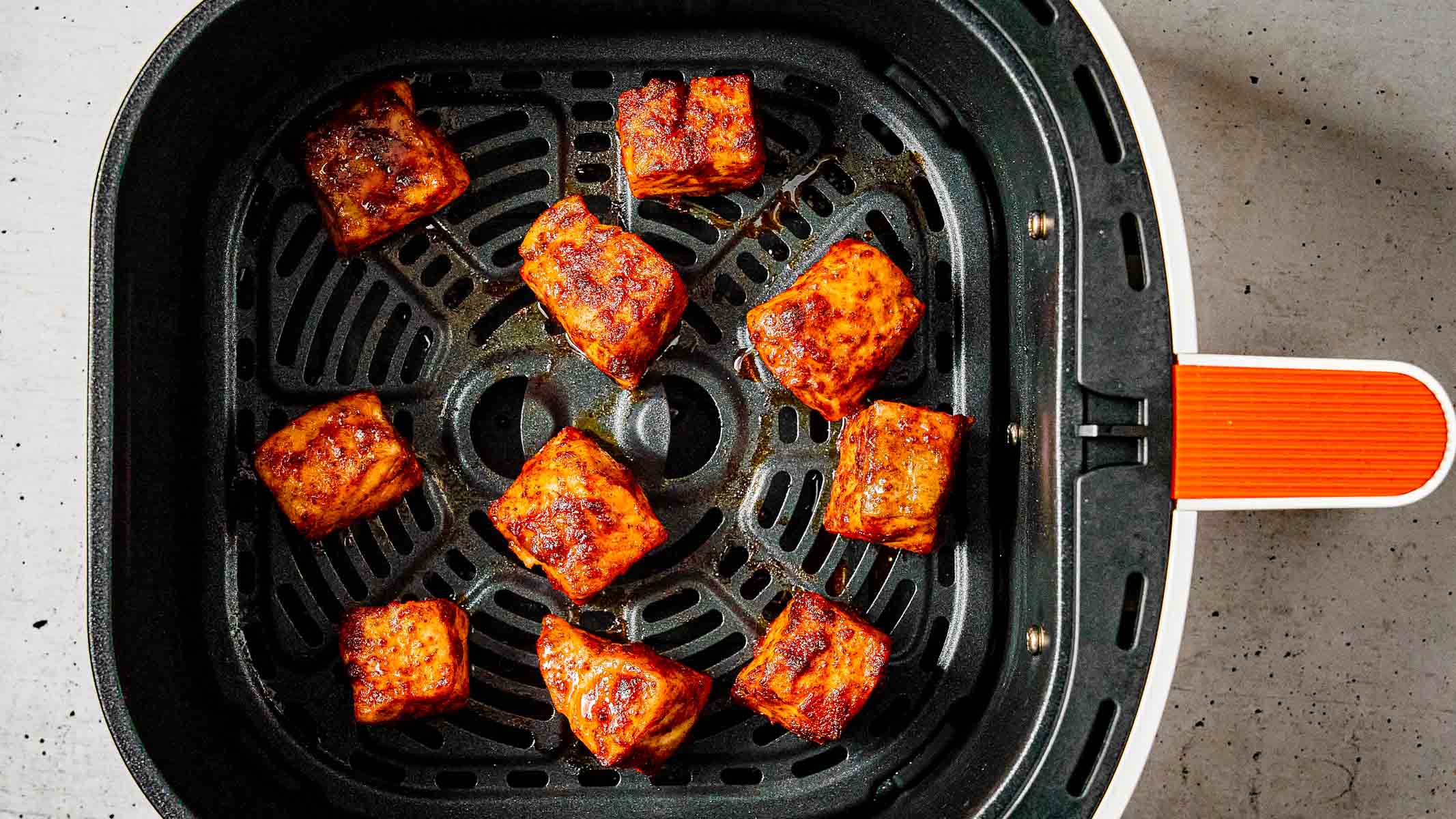
I test most of my air fryer recipes, including the Air Fryer Salmon Bites on this site, in a Ninja Air Fryer Max XL or the Cosori TurboBlaze and it's worth putting the two side by side. Both hit 450°F, both are marketed as fast, powerful crispers, and both show up constantly in "best air fryer" roundups - but they get there in different ways, and that difference actually changes how a recipe like salmon bites, wings, or fries turns out.

Here's the jest on both air fryers. The Cosori has bake, toast, air fry, warm, roast, broil, pizza, dry, and proof settings, plus a rotisserie - I haven't turned my oven on all summer except to bake a roasting pan full of cabbage rolls. I also like the Ninja air fryer, which has reheat, air fry, dehydrate, roast, grill, and bake settings. It just won't fit a 6 lb chicken unless you cut it up first.
Cosori TurboBlaze
Cosori Turboblaze Smart Air Fryer 6 Quarts is highly regarded as one of the best basket-style air fryers on the market. Unlike traditional air fryers, it uses a unique DC motor instead of an AC motor. This technology allows the appliance to dynamically adjust between 5 different fan speeds and change its airflow based on the preset you select. It cooks up to 46% faster than previous Cosori models while running remarkably quiet.
Key Features
- Wide Temperature Range: Operates from 90°F up to 450°F.
- 9-in-1 Versatility: Features modes for Air Fry, Roast, Broil, Frozen, Bake, Reheat, Dehydrate, Warm, and Proof for bread dough.
- Roomy Basket: The 6-quart basket features a wide, square footprint that fits more food in a single layer for more even crisping.
- Easy to Clean: Outfitted with a PFAS-free ceramic coating on the basket and crisper plate, both of which are dishwasher-safe.

Ninja Air Fryer Max Xl
Ninja Air Fryer Max Xl is one of the most popular basket-style air fryers on the market. Unlike many standard air fryers that max out at 400°F, this unit features a specialized Max Crisp Technology. This system delivers 450°F of superheated air to cook frozen foods up to 30% faster, making it excellent for achieving a deep-fried crunch on wings and fries.
Key Features
- Temperature Range: Spans from 105°F to 450°F.
- 7-in-1 Versatility: Includes settings for Max Crisp, Air Fry, Air Roast, Air Broil, Bake, Reheat, and Dehydrate.
- Round Basket Capacity: The 5.5-quart basket is deeper and can hold up to 3 lbs of French fries or chicken wings.
- Premium Coating: Features a ceramic-coated nonstick basket and crisper plate that are completely dishwasher-safe.
- Extra Accessories: Comes packed with an included metal broil rack to layer food or get items closer to the heating element.

Cosori TurboBlaze vs Ninja Max XL: Specs at a Glance
| Spec | Cosori Turbo | Ninja Air Fryer Max |
|---|---|---|
| Max temp | 450°F | 450°F |
| Min temp | 90°F | 105°F |
| Capacity | 6.0–6.3 qt (measured) | 5.5 qt |
| Basket surface area | 75.5 in² | ~64.9 in² (comparable Ninja model) |
| Fan speeds | 5 speeds, up to 3,600 RPM | Single high-speed fan, ~3,000–3,100 RPM |
| Preheat to 400°F | ~3:02 | ~2:17 |
| Temp stability at 400°F | ±42°F variation | ±14°F variation |
| Dishwasher-safe basket | Yes | Yes |
| Cooking presets | 9 (Air Fry, Roast, Broil, Frozen, Reheat, Bake, Dry, Proof, Keep Warm) | 5 (Max Crisp, Air Fry, Air Roast, Bake, Reheat, Dehydrate) |
Is the Cooking Space Wide and Flat, or Deep and Narrow?
This is really the more important difference between the two, since it affects how food actually cooks.
The Cosori has a wide, shallow, almost-square basket - about 9.25 x 9.25 inches, but only around 3.25 to 3.4 inches deep. That shape gives it a much larger cooking surface area (measured at 75.5 square inches) so food sits in a single flat layer and crisps more evenly. It's roomy enough to fit an 8x8-inch baking pan, which the Ninja can't accommodate.
The Ninja Max XL has a narrower, deeper, bowl-shaped basket - about 8.25 inches across but nearly 5 to 6 inches deep. Its cooking surface measures only about 49.9 square inches, roughly a third smaller than the Cosori's. That extra depth is handy for piling in a big batch of wings, but food tends to stack rather than spread out, which can mean less even crisping and a "feels smaller than it sounds" experience despite the quart rating.
Bottom line: Cosori = wide and flat. Ninja = deep and narrow.
Will Either Fit Easily on a Standard Kitchen Counter?
Yes, both are counter-friendly, but they take up space differently.
- Cosori Turbo Blaze: about 11.6 inches wide, 14.4 inches deep, 11.7 inches tall. It's fairly compact and cube-like, so it tucks under most upper cabinets without issue.
- Ninja Max XL: about 11.0 inches wide, 14.2 inches deep, 14.6 inches tall. It's almost identical in width and depth to the Cosori, but nearly 3 inches taller.
Depth-wise, they're nearly twins (around 14.2-14.4 inches), so both will sit comfortably on a standard 24-25 inch deep counter. The real question is vertical clearance: if you plan to keep your air fryer stored under a cabinet or range hood, the Cosori's shorter, squatter profile (11.7 inches tall) fits more comfortably than the Ninja's taller 14.6-inch height. Neither model is heavy enough to worry about counter stability - the Cosori weighs around 14.1 pounds.
Wattage: Above 1,700W?
Both are rated above 1,700W on paper - Cosori at 1,725W, Ninja at 1,750W. But lab tests show their real power draw is nearly identical: Ninja pulls about 1,535W and Cosori about 1,510W. So wattage alone doesn't decide which cooks faster - basket shape matters just as much.
How Close Is Food to the Heating Element?
The Cosori's basket is wide and shallow, so food sits closer to the top heating element across the whole surface, giving more even browning. The Ninja's basket is deeper, so food sits farther from the element, especially at the bottom of a full load - you may need to shake the basket partway through for even cooking.
Does It Take Long to Preheat?
Neither takes long. The Ninja preheats faster, hitting 400°F in about 2.5 minutes. The Cosori takes a bit longer, about 3 minutes to hit the same temperature. Both are quick, but Ninja has a slight edge getting started, while Cosori tends to cook a bit faster once it's hot.
Both Hit 450°F, But They Get There Differently
Yes, both machines advertise a 450°F ceiling, so on paper they're tied for max heat. Where they split is fan behavior, not top temperature. The Cosori TurboBlaze runs a DC motor with five distinct fan speeds, topping out at 3,600 RPM in its "Turbo" modes, which is technically a higher maximum fan speed than most Ninja models test at. The Ninja Max XL, by contrast, uses a single high-speed fan tuned for one purpose: blast hot air fast and hard in its Max Crisp setting.
In practice, that means the Ninja's airflow feels more aggressive and immediate once it's running, closer to a compact convection broiler than a traditional air fryer, while the Cosori's multi-speed fan lets you dial airflow down for gentler jobs like dehydrating or proofing dough, and up for a genuinely faster crisp when you want it. If you only ever use one setting, the Ninja's single-mode blast is simpler and more consistent. If you cook a wider range of foods, the Cosori's flexibility is the bigger asset.
Temperature Stability Matters More Than Peak Temperature
This is the spec that actually affects recipe results the most, and it's the one most comparison articles skip. RTINGS measured the Cosori TurboBlaze's temperature swinging by about 42°F during cooking at a 400°F setting, while the Ninja held steady within about 14°F. That gap is why the Ninja tends to produce more predictable results recipe to recipe: when a recipe says "450°F for 4 minutes," a machine that holds closer to that number the whole time is going to match the recipe's timing more reliably than one that's cycling between 380°F and 420°F to average out at 400°F.
For something like salmon bites, where the difference between moist and dry is measured in seconds, not minutes, that stability is the deciding factor more than either machine's top-end temperature.
Basket Capacity: How Many Quarts?
The Cosori Turbo Blaze is rated at 6.0 quarts (5.7 liters), and independent lab testing found it actually holds a bit more - closer to 6.3 quarts (6.0 liters) in practice. Cosori's own listing even states 6.5 quarts for the basket.
The Ninja Air Fryer Max XL is rated at 5.5 quarts (5.2 liters), and testing confirmed it holds exactly that - no bonus space here.
So if raw capacity is your main concern, the Cosori edges out the Ninja by roughly half a quart to a full quart, depending on whose measurement you use.
Is the cosori TurboBlaze a dual basket?
No. Cosori is a single basket. If you want a dual-basket model from the same brand, Cosori makes the Cosori 9.0-Quart Dual Basket Air Fryer, which features two separate, independently controlled 4.5-quart baskets. Note: Do not confuse the "TurboBlaze" with Cosori's "Dual Blaze" model-the Dual Blaze is also a single-basket air fryer, but it is named "Dual" because it has two heating elements-one on top and one on the bottom-rather than two separate food baskets.
Is Ninja Air Fryer Max XL A Single Basket?
Yes, it's a single basket air-fryer. It features one large 5.5-quart non-stick ceramic basket and a matching crisper plate. For dual-basket options, Ninja offers the Ninja DualZone series (such as the 8-quart or 10-quart 2-basket models) and the Ninja DoubleStack series (which features two vertically stacked baskets to save counter space).
Are the Parts Dishwasher Safe?
Yes for both. The Cosori's basket and crisper plate are dishwasher-safe, though hand washing takes less than a minute and is gentler on the ceramic coating. The Ninja's basket and crisper plate are also dishwasher-safe, but Ninja's manual recommends hand washing to help the nonstick coating last longer. So both can go in the dishwasher, but hand washing is the safer choice for long-term coating health on either one.
Is the Touchscreen Simple to Use?
The Cosori uses a digital touchscreen. It looks clean and modern, but it shows fingerprints and dust easily, and a couple reviewers noted it can be a bit fussy to keep looking clean. Functionally though, it's straightforward once you learn the icon layout.
The Ninja uses physical buttons instead of a touchscreen. Some reviewers actually see this as an advantage - buttons feel more durable and don't get confused by greasy fingers the way a touchscreen sometimes can.
Bottom line: neither is complicated, but if you want a sleeker look, Cosori's touchscreen wins on style. If you want something simple and grease-proof, Ninja's buttons are more foolproof.
Does It Smell Like Plastic on First Use?
Yes, both do, and it's completely normal for a new air fryer, not a defect.
There's a noticeable plasticky smell on the very first run for Cosori - strong enough that I needed to open a window and turn on a fan. The fix is simple: run it empty at around 385°F for 10 minutes, ventilate the room, then wash the basket and crisper plate afterward. The smell fades by the second or third empty run.
The Ninja has the same issue on first use. I do the same thing: wash all removable parts first, then run the unit completely empty at 400°F for 15-20 minutes with a range hood on or window open, repeating two to three times. Most smell clears up within those first few cycles.
One safety note: if you ever notice clicking sounds, melting, warping, or a smell specifically coming from the cord or plug (rather than the basket interior), that's not normal - unplug immediately and stop using it.
Which One Should You Buy for Crispy Recipes?
Neither machine is objectively better across the board; they're built around different priorities.
Choose the Ninja Max XL if you want consistent, repeatable results and mostly cook single-layer proteins like salmon, chicken, or pork chops, where matching a recipe's exact temperature and timing matters more than batch size.
Choose the Cosori TurboBlaze if you cook for more people at once, want a bigger basket to avoid multiple batches, or use your air fryer for a wider range of tasks like dehydrating fruit or proofing dough, where the extra fan speed options are genuinely useful.
Frequently Asked Questions
Does the Cosori TurboBlaze run hotter than the Ninja Max XL?
Both max out at 450°F, so neither runs hotter at the top end. The Cosori's fan cycles through wider temperature swings during cooking, which can make food closer to the outer edge of the basket cook faster in bursts, even though the average temperature matches the setting.
Which air fryer is better for salmon?
The Ninja Max XL's more stable temperature makes it easier to hit a precise doneness window, which matters for salmon since a minute of overcooking is the difference between moist and dry. The Cosori's larger basket is an advantage if you're cooking more than a pound at once and want to avoid a second batch.
Do both air fryers need a recipe timing adjustment?
Recipes developed on one machine may need a slight timing adjustment on the other. If a recipe was tested on a Ninja and you're using a Cosori (or vice versa), check food 1-2 minutes before the stated time the first time you make it, then adjust for future batches based on your results.




Comments
No Comments