What's in the Pan

  • Subscribe
  • Grill and Smoker
  • Skewers and Kebabs
  • Steak
  • Desserts
    • No Bake
  • Popular
  • Traditional Italian Recipes
  • Cast Iron
  • Guides
  • Olya Shepard
menu icon
go to homepage
  • Subscribe
  • Grill and Smoker
  • Skewers and Kebabs
  • Steak
  • Desserts
    • No Bake
  • Popular
  • Traditional Italian Recipes
  • Cast Iron
  • Guides
  • Olya Shepard
search icon
Homepage link
  • Subscribe
  • Grill and Smoker
  • Skewers and Kebabs
  • Steak
  • Desserts
    • No Bake
  • Popular
  • Traditional Italian Recipes
  • Cast Iron
  • Guides
  • Olya Shepard
×
Home » Side Dishes

Ukrainian Fermented Cabbage and Carrots (3-Day Recipe)

Updated: August 15, 2026 · Published: August 15, 2026 6:23 pm by Olya Shepard · Leave a Comment

  • Facebook
This post may contain affiliate links. Please see our Affiliate Policy
Jump to Recipe - Print Recipe

This fermented cabbage and carrots recipe has been passed down in my Russian-Ukrainian family for as long as I can remember - and the science behind it explains exactly why it works.

By · Creates gluten-free, high-fiber recipes that are simple, nutritious, and full of flavor.
Olya
Olya Shepard

I'm the creator of WhatsInThePan, and for nearly a decade I've been passionate about creating gluten-free, high-fiber recipes that are both nourishing and delicious.

View full bio
Fermented Cabbage and Carrots: A 3-Day Family Sauerkraut Recipe

My mom has made this dish since before I was born, and I've been lucky enough to eat it my whole life. It follows the classic Eastern European approach: a precise 1kg cabbage to 20g salt ratio, which comes out to about 2% salt by weight - the same benchmark food-science sources point to as the sweet spot for safe, crisp fermentation. My parents used crocks and a plate on top with a weight to keep cabbage under the juices and my father would pound the cabbage in the salt to get it juicy.

Whether its roots are more Russian or Ukrainian, I honestly can't say for certain given my own mixed heritage, but the technique lines up with what other Ukrainian home cooks describe as their own family traditions: shredded cabbage and grated carrot massaged with salt, packed tightly, weighted down so brine stays above the vegetables, and pierced daily to let trapped fermentation gas escape.

Ukrainian Fermented Cabbage and Carrots (3-Day Recipe)

The Science Behind The Ratio And Technique

Keeping a weight on top ensures the brine stays above the cabbage at all times, which starves off oxygen-loving spoilage organisms and protects the batch from harmful bacteria.

Salt isn't just for flavor - it's a critical safety mechanism. It draws water out of cabbage cells via osmosis to create the brine, and the lactic acid the bacteria produce is what suppresses harmful bacteria.

I want to emphasize that salt must be measured precisely rather than ball park, and that you should never use substitutes like iodized table salt, since iodine can inhibit fermentation.

Yes, I pierce the cabbage down to the bottom of the jar (with a chopstick or a dull end of butter knife) and it isn't just tradition - it serves a real function. As lactic acid bacteria ferment the cabbage, they produce carbon dioxide that gets trapped in pockets throughout the packed mass. Most modern recipes handle this with a daily "burp" - cracking the lid to release built-up pressure - but the skewer method goes a step further: it physically releases gas trapped deep within the cabbage itself, not just in the jar's headspace, which can help keep the brine in more even contact with the vegetables and reduce the risk of cabbage being pushed above the brine line.

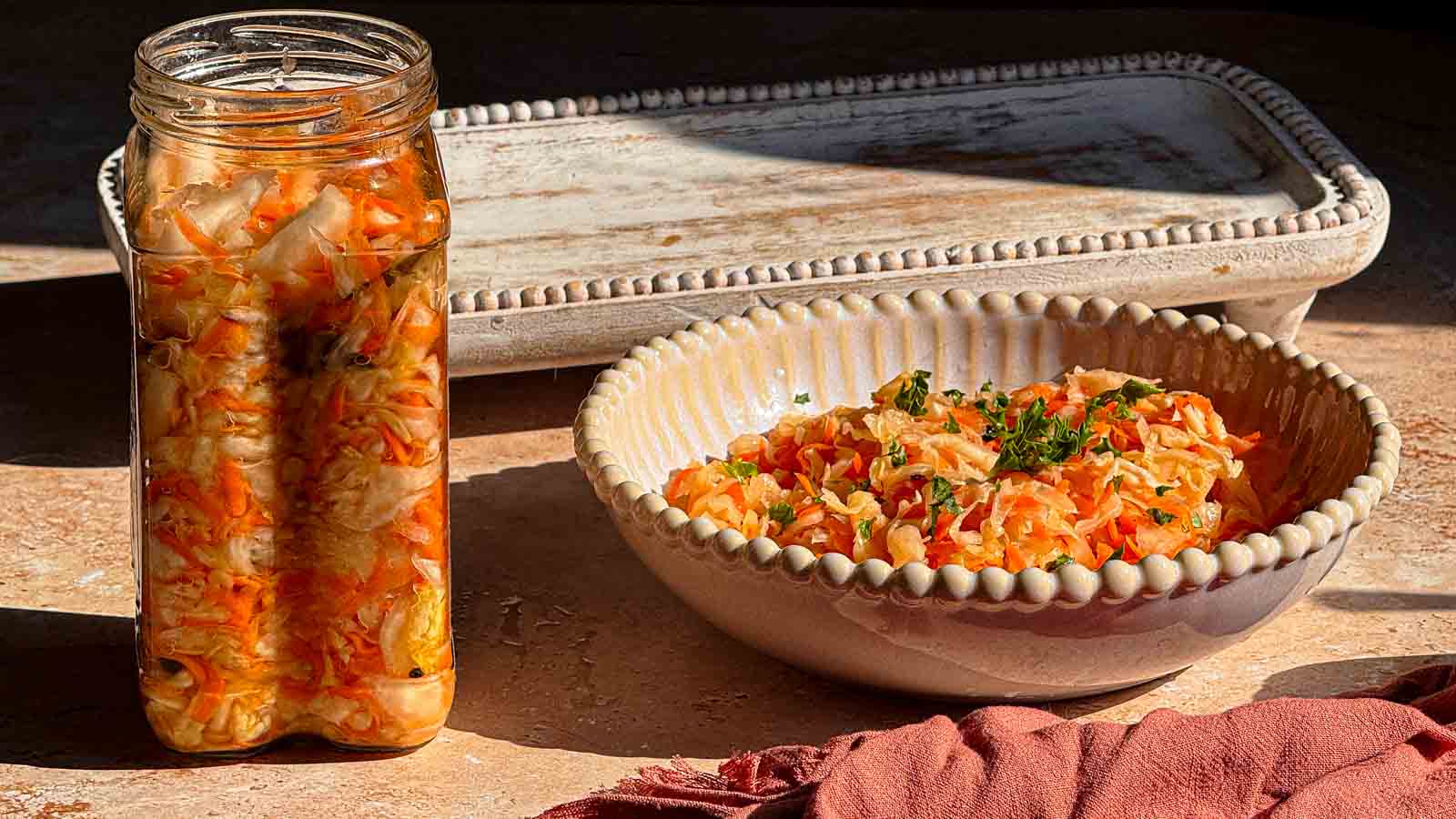
fermented cabbage and carrots in a jar and on a plate

Fermented Cabbage and Carrots (Family Sauerkraut Recipe)

A simple, three-ingredient fermented cabbage and carrot recipe passed down through generations in my Russian-Ukrainian family. Made with just cabbage, carrot, and a precise 2% salt ratio, this quick-fermenting sauerkraut is ready to eat in just three days, with a mild, tangy crunch that gets more sour the longer it sits in the fridge. No special equipment needed - just a jar, a weight, and a skewer for daily de-gassing.
5 from 2 votes
Print Pin
Course: Condiment, Fermented Food, Side Dish
Cuisine: Eastern European, Russian, Ukrainian
Keyword: fermented cabbage, fermented cabbage and carrots, homemade sauerkraut recipe, quick sauerkraut, Russian sauerkraut, Ukrainian sauerkraut
Prep Time: 20 minutes minutes
Fermentation/Resting Time: 3 days days
Total Time: 3 days days 20 minutes minutes
6
Author: Olya Shepard

Equipment

  • Kitchen scale
  • large mixing bowl
  • Fermentation jar (or wide-mouth glass jar, 1-1.5 quart / 1-1.5 liter)
  • Light fermentation weight (a shot glass, small jam jar, or coffee cup works well)
  • Wooden skewer or chopstick (for daily de-gassing)

Ingredients

Vegetables

  • 2.2 lb. green cabbage, thinly sliced
  • 1 medium carrot coarsely grated

Seasonings

  • 20 g coarse salt pickling or kosher - see Notes for measuring by weight vs. volume
  • 1 teaspoon whole black peppercorns

Instructions

  • Thinly slice the cabbage and coarsely grate the carrot.
  • Weigh the cabbage and carrot together, then calculate 2% of that weight in salt (20 g salt per 1 kg vegetables) to keep the ratio precise.
  • Combine the cabbage, carrot, black peppercorns and salt in a large bowl and mix thoroughly by hand, massaging gently until the cabbage begins to release liquid.
  • Pack the mixture tightly into your jar, pressing down firmly by hand as you go to remove air pockets and force the liquid to rise above the vegetables.
  • Place a light weight, such as a shot glass or small jam jar, directly on top of the cabbage to keep it fully submerged in its own brine.
  • Leave the jar at room temperature for 3 days. The cabbage should stay fully covered in liquid throughout fermentation; this is the most important visual check for food safety.
  • Twice a day, pierce the cabbage in 4-5 places down to the bottom of the jar with a wooden skewer or chopstick to release trapped carbon dioxide from within the mass, not just from the surface.
  • After 3 days, transfer the jar to the refrigerator. It's ready to eat immediately, and it will continue to develop a more pronounced sour flavor over the following weeks in the fridge.
Calories: 48kcal

Notes

Diet: Vegan, Vegetarian, Gluten-Free, Dairy-Free
Measure salt by weight, not volume. A teaspoon of salt can range from about 3 g (Diamond Crystal kosher) to 5 g (Morton kosher) to 6 g (table salt) depending on the brand, since crystal size changes how much fits in a spoon. Using a kitchen scale for the 20 g is far more reliable than any teaspoon conversion, and it's what keeps this ratio consistent batch after batch.
If your cabbage doesn't release enough brine to fully submerge itself within the first few hours, top it off with a matching 2% saltwater brine (2 g salt per 100 g water) rather than adding more dry salt to the mix.
Don't use iodized table salt or salt substitutes. Iodine and anti-caking agents can inhibit fermentation and cloud the brine, which is why pickling or kosher salt is standard for this method.
A thin white film on the surface (kahm yeast) is usually harmless and can be skimmed off; it tends to form when the cabbage isn't kept fully submerged. Fuzzy colored mold, on the other hand, means the batch should be discarded. Keeping the weight on and checking submersion in the first day or two is the best way to avoid both.
Leave at least an inch of headspace in your jar. The cabbage will bubble and expand during the first couple of days as fermentation gets going, and a jar packed too full can overflow.
This is a "young" sauerkraut by design. Its 3-day ferment is much shorter than the 1–4 week timeline common in Western recipes, giving a milder, slightly sweet tang rather than a fully sour flavor. If you prefer more sourness, simply let it sit longer in the fridge; the flavor deepens gradually over the following weeks.
Nutrition Facts
Fermented Cabbage and Carrots (Family Sauerkraut Recipe)
Amount per Serving
Calories
48
% Daily Value*
Fat
 
0.2
g
0
%
Saturated Fat
 
0.1
g
1
%
Polyunsaturated Fat
 
0.05
g
Monounsaturated Fat
 
0.04
g
Sodium
 
1329
mg
58
%
Potassium
 
325
mg
9
%
Carbohydrates
 
11
g
4
%
Fiber
 
5
g
21
%
Sugar
 
6
g
7
%
Protein
 
2
g
4
%
Vitamin A
 
1865
IU
37
%
Vitamin C
 
61
mg
74
%
Calcium
 
74
mg
7
%
Iron
 
1
mg
6
%
* Percent Daily Values are based on a 2000 calorie diet.
Fermented Cabbage and Carrots: A 3-Day Family Sauerkraut Recipe

How This Compares To Most Western Recipes

A three-day timeline is a faster, milder ferment by design next to the 1-to-4-week range cited by most extension and food-safety sources. My family's version is fermented faster and milder by design - a 'young' kraut with a lighter, slightly sweet tang, rather than a fully sour, long-aged one. If you prefer more tang, letting it sit longer in the fridge is a common next step.

Important Visual Cue

The cabbage should stay fully covered in its own released liquid - this is the single most important food-safety checkpoint in the whole process, since oxygen exposure at the surface is what invites mold rather than the fermentation you want. If a jar produces less juice than expected, most sources recommend topping off with a matching 2% saltwater brine rather than adjusting the salt already mixed in.

Adjusting Salt for Cabbage Size

I usually use 25 grams of salt for small cabbage, 30 grams for medium, and 35 for large one.

Family Variations: Apples, Raisins, and Onions

I often add raisins, small apple slices and cranberries before starting the fermentation process. I also like to add onions, but after the fermentation is complete.

More Side Dishes

  • Whipped Feta with Roated Kalamata Olives
    Cool Summer Side Dishes, Dips, Appetizers and Finger Foods
  • Black Bean Avocado Salad on a plate
    15 Favorite 4th of July Make Ahead Side Dishes
  • Grilled vegetable salad with eggplant, zucchini, peppers, sweet onion, crumbled feta, toasted walnuts, mint, and dill
    No-Oil Charred Mediterranean Grilled Vegetables
  • slow cooker creamed corn
    35+ Best BBQ Side Dishes for Any Cookout or Backyard Party

Comments

No Comments

5 from 2 votes (2 ratings without comment)

Leave a Reply Cancel reply

Your email address will not be published. Required fields are marked *

Click on stars to rate the recipe!


Hi, I'm Olya! Welcome to the online home of my recipes that will make you look like a pro, yet without having to spend too much time in the kitchen! More about me →

Most Recent:

  • Fermented Cabbage and Carrots: A 3-Day Family Sauerkraut Recipe
    Ukrainian Fermented Cabbage and Carrots (3-Day Recipe)
  • Tomato Season - Heirloom Tomatoes
    When Is Tomato Season? Your Guide to Peak Tomato Perfection
  • A decorated purple velvet cake finished with blackberries and blueberries.
    Red Velvet Cake with Purple Frosting and Blackberries
  • salmon bites on an air fryer
    Cosori TurboBlaze vs Ninja Air Fryer Max XL: Which One Actually Cooks Better?

Footer

↑ back to top

Privacy Policy

Affiliate Disclosure

Disclaimer

Contact Me

About

Work with me

Pinterest

Facebook

Instagram

Copyright © 2016-2025 Whatsinthepan.com

Click on Stars

Your vote:


A rating is required
A name is required
An email is required

Recipe Ratings without Comment

Something went wrong. Please try again.