
When I first upgraded my Vitamix and saw the Smoothie setting, I assumed it was just "high speed with a fancy name." After living with it for a while, I realised it follows a very specific pattern that takes a lot of guesswork out of breakfast. It's brilliant for certain blends and totally unnecessary for others. Here, I'm breaking down exactly what that button does, which smoothies it's perfect for, and when I still prefer to drive the speed dial myself.

The Smoothie preset on a Vitamix is a 45-50 second automated blend cycle that handles the entire speed sequence for you - slow start, high-speed run, automatic stop. It sounds simple, and it is, but understanding why the machine behaves the way it does - especially that deliberate slow start that confuses almost every new owner - is what separates people who get consistently great smoothies from people who keep getting air pockets, uneven chunks, and foam.
Getting your smoothie settings right is one of the fastest ways to level up your blending game. New to the machine? My Ultimate Guide to Using a Vitamix Blender is the best place to start before diving into settings.
What the Smoothie Mode Actually Does
When you press the Smoothie preset on an Ascent or Propel series Vitamix, the machine runs a pre-programmed ramp sequence that Vitamix engineers designed and tested to produce a fully smooth result on the widest possible range of ingredients. It is not a single static speed. It is a choreographed series of speed changes:
- Starts at low speed (approximately Speed 1-2) for several seconds
- Ramps gradually upward through the mid-range speeds
- Accelerates to full speed (10) and holds there for the bulk of the cycle
- Stops automatically when the timer expires - typically around 45-50 seconds
The machine does all of this without any input from you after pressing the button. You load ingredients, press the preset, and walk away.
The Smoothie preset is essentially a programmed sequence of variable speeds - if you want to understand exactly how those speeds work under the hood, my Vitamix variable speeds explanation goes deeper on the mechanics.
Why the Smoothie Mode Starts Slow
This is the question every new Vitamix owner asks - usually while staring at the machine wondering if something is broken. The slow start is not a flaw or a warmup quirk. It is deliberate motor and blade physics, and it matters.
The Vortex Has to Form First
When the blades start spinning, they need to pull the ingredients downward into the cutting zone from the center of the container. This creates the characteristic Vitamix vortex - the tornado-like funnel that keeps ingredients cycling continuously from the bottom of the container up through the blend and back down. If the blades hit full speed before that vortex is established, the ingredients don't get pulled in - they get flung outward against the container walls, creating a ring of material that spins uselessly around the outside while the blades chop air in the middle.
Starting slow gives the blades a few seconds to grab the ingredients and create the initial pull, establishing the vortex before the speed surges.
It Prevents Explosive Splatter
Dense, heavy ingredients - frozen fruit, ice cubes, nut butter, thick Greek yogurt - sit at the top of the liquid when the machine starts. A full-speed cold start would hit those ingredients before they've had any movement and violently throw them against the lid, causing splatter under the lid and an uneven blend. The slow start gives the heavier ingredients time to begin falling toward the blades under gravity before the motor speed creates enough centrifugal force to throw them sideways.
It Protects the Motor Long-Term
Starting a high-torque motor under a full load - meaning cold, stationary blades suddenly trying to spin through dense, heavy ingredients at maximum speed - creates a large inrush current surge that stresses both the motor windings and the carbon brushes. Starting slow dramatically reduces that stress by letting the motor come up to speed gradually, where the ingredients are already moving and offering less resistance. High-speed operation after the initial ramp actually draws in more air to cool the motor internally, meaning the end of the cycle is better for the motor's health than the start would be at full throttle.
How to Use Smoothie Mode Step by Step
Load the Container in the Correct Order
Loading order is not optional - it directly determines whether the Smoothie preset produces a vortex or an air pocket:
- Liquids first - water, milk, juice, or yogurt (creates the initial vortex medium)
- Soft fruits - fresh banana, mango, peach, berries
- Leafy greens - spinach, kale, herbs (sandwiched between soft and frozen so they don't float)
- Frozen fruit or ice last - sits on top and presses everything down toward the blades
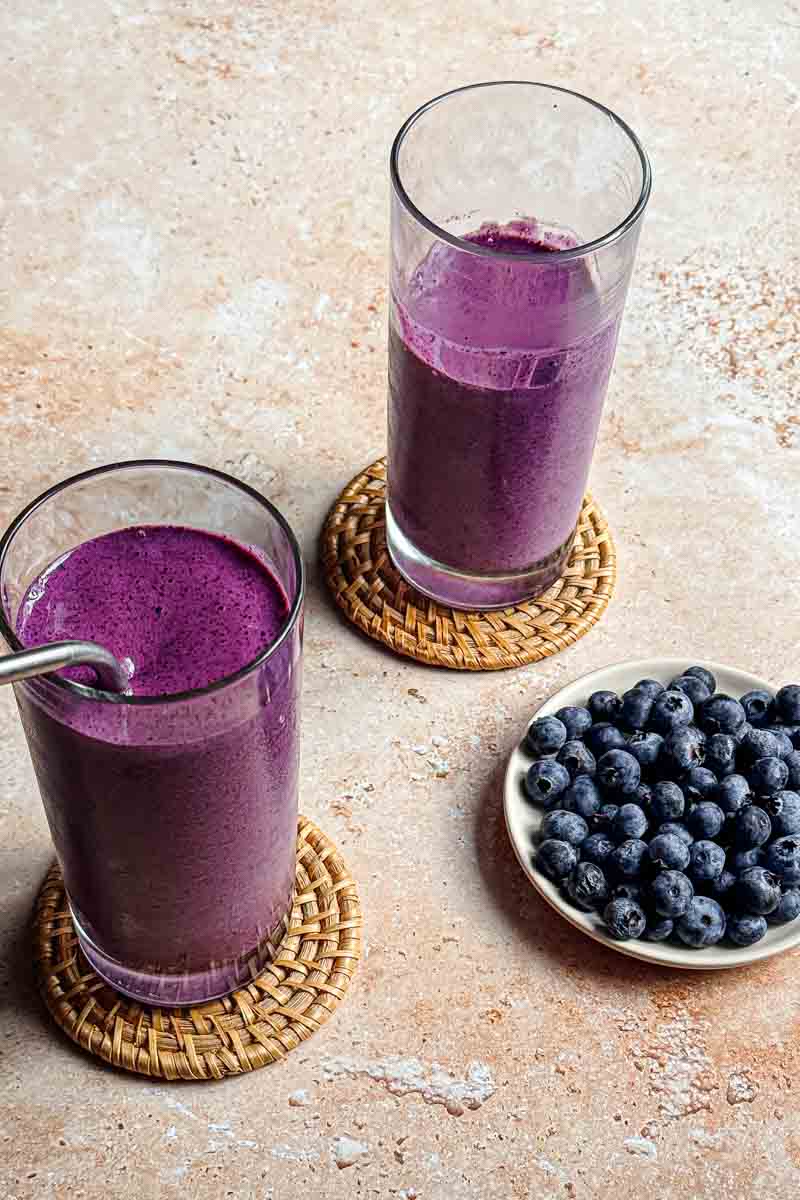
Never reverse this order. Putting frozen fruit on the bottom creates a dense, blade-blocking puck that the vortex can't penetrate, even with the preset's slow start. This is exactly what I do when I make my Blueberry Protein Smoothie.
Press and Walk Away - With One Caveat
Once your container is loaded and sealed, press the Smoothie preset. The machine starts low, ramps, runs at full speed, and stops automatically in about 45-50 seconds. During the high-speed phase, check the vortex through the container. A properly formed vortex looks like a steady funnel of movement - a smooth, consistent pull toward the center.
If you see the blend stalling - ingredients spinning in a ring around the outside, a still spot in the center, or the machine sounding strained - the preset won't fix it on its own. Stop the machine, remove the lid plug, insert the tamper, and press down firmly into the stalled area to break the blockage, then restart the preset.
What to Do If the Smoothie Is Still Chunky
The preset runs a fixed timer. It doesn't know whether your frozen mango was extra-dense or your kale stems were particularly fibrous. If the cycle ends and you find chunks, simply restart the preset for a second 45-second cycle, or switch to manual Speed 10 and run for an additional 15-20 seconds. The machine can handle it - there is no harm in running a second cycle.
The Foam Problem (And the Fix)
A common complaint about the Smoothie preset is excess foam on top of the finished blend. This is not a machine problem - it is a physics problem. At high speed, the blades introduce air into the smoothie as the vortex pulls the surface of the liquid toward the blades. The slower the minimum speed of your model, the better it can run a foam reduction phase at the end of the cycle.
The fix is simple: after the preset finishes, switch to manual and run at Speed 1 for 10-15 seconds. The slow speed allows the larger air bubbles to rise and pop while gently agitating the smoothie. The result is a notably denser, less foamy texture when you pour. This technique works on every Vitamix model regardless of preset availability.
Smoothie Mode vs. Manual Variable Speed: Which Is Better?
The honest answer is that they produce the same result when executed correctly - because the preset is simply automating the same ramp technique you'd do manually. The real difference is operational:
| Smoothie Preset | Manual Variable Speed | |
|---|---|---|
| Speed ramp | Automated, fixed | You control, adaptable |
| Blend time | Fixed (~45–50 sec) | You decide when it's done |
| Response to density | None — same program regardless of load | Real-time — you can add time, use tamper, adjust mid-blend |
| Foam reduction | Not built in | Easy to add manually at end |
| Best for | Consistent daily routine, beginners | Experienced users, variable recipes |
| Convenience | High — press and walk away | Moderate — requires attention |
The preset's biggest weakness is the one its biggest strength creates: it doesn't know what's in the container. A 16-oz light smoothie gets the same 50-second high-speed treatment as a 64-oz frozen fruit blend - which can mean over-processing thin smoothies into a warm, airy result, or under-processing an unusually dense one. Manual speed lets you read the blend by sound and sight and stop exactly when the texture is right.
For a repeatable morning smoothie you make five days a week from the same ingredients in the same quantities, the preset is genuinely excellent. For recipe development, batch work, or anything with variable ingredient density, manual control wins every time.
Once you've blended the perfect smoothie, make it last. My guide on how to store smoothies covers fridge and freezer storage so your batches stay fresh all week.
Smoothie Mode FAQ
Why does my Vitamix smoothie mode start so slowly?
The slow start establishes the blending vortex before full speed surges, prevents frozen ingredients from splattering against the lid, and protects the motor from high-torque inrush stress on a cold start. It is intentional and is one of the features that makes Vitamix results consistently better than machines that start at full speed.vitamix+1
How long does Vitamix smoothie mode run?
Approximately 45-50 seconds on most Ascent and Propel models. The A3500 runs a 50-second smoothie cycle; some users find a 40-second run produces equally good results for a standard fruit smoothie and generates less heat in the finished drink.youtube
Can I use smoothie mode without the preset button?
Yes - the manual equivalent is to start at Speed 1, ramp smoothly to Speed 10 over about 5 seconds, run at Speed 10 for 35-40 seconds, then drop back to Speed 1 for 10 seconds to reduce foam before stopping.nutritionrefined+1
What if my Vitamix doesn't have a smoothie preset?
Models like the Explorian E310 and the 5200 have no presets - only the variable speed dial. Use the manual technique above: Speed 1 → ramp to 10 in 5 seconds → hold 40 seconds → drop to 1 for 10 seconds → stop.
Why is my Vitamix smoothie foamy?
Foam is created by the high-speed vortex pulling air into the blend during the main cycle. After the preset or manual cycle ends, drop to Speed 1 and run for 10-15 seconds - this breaks up and releases the trapped air bubbles and produces a noticeably smoother, denser texture when poured.
More Vitamix Resources
Smoothie settings are just the start. If you're still getting comfortable with your machine, our Ultimate Guide to Using a Vitamix Blender covers all the basics - and our Vitamix variable speeds explanation goes even deeper on the mechanics. Ready to batch blend? Our guide on how to store smoothies will keep everything fresh.

Comments
No Comments