
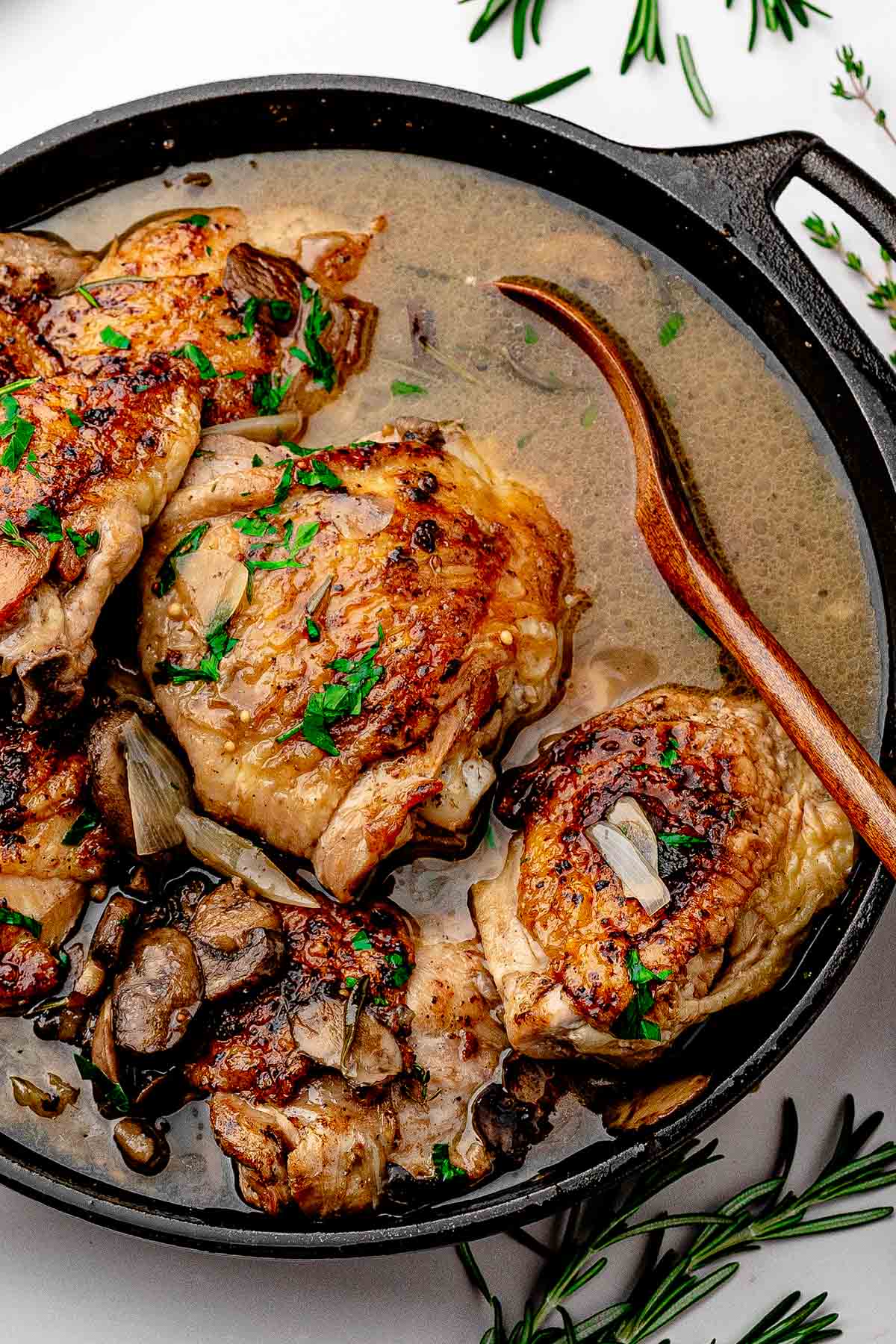
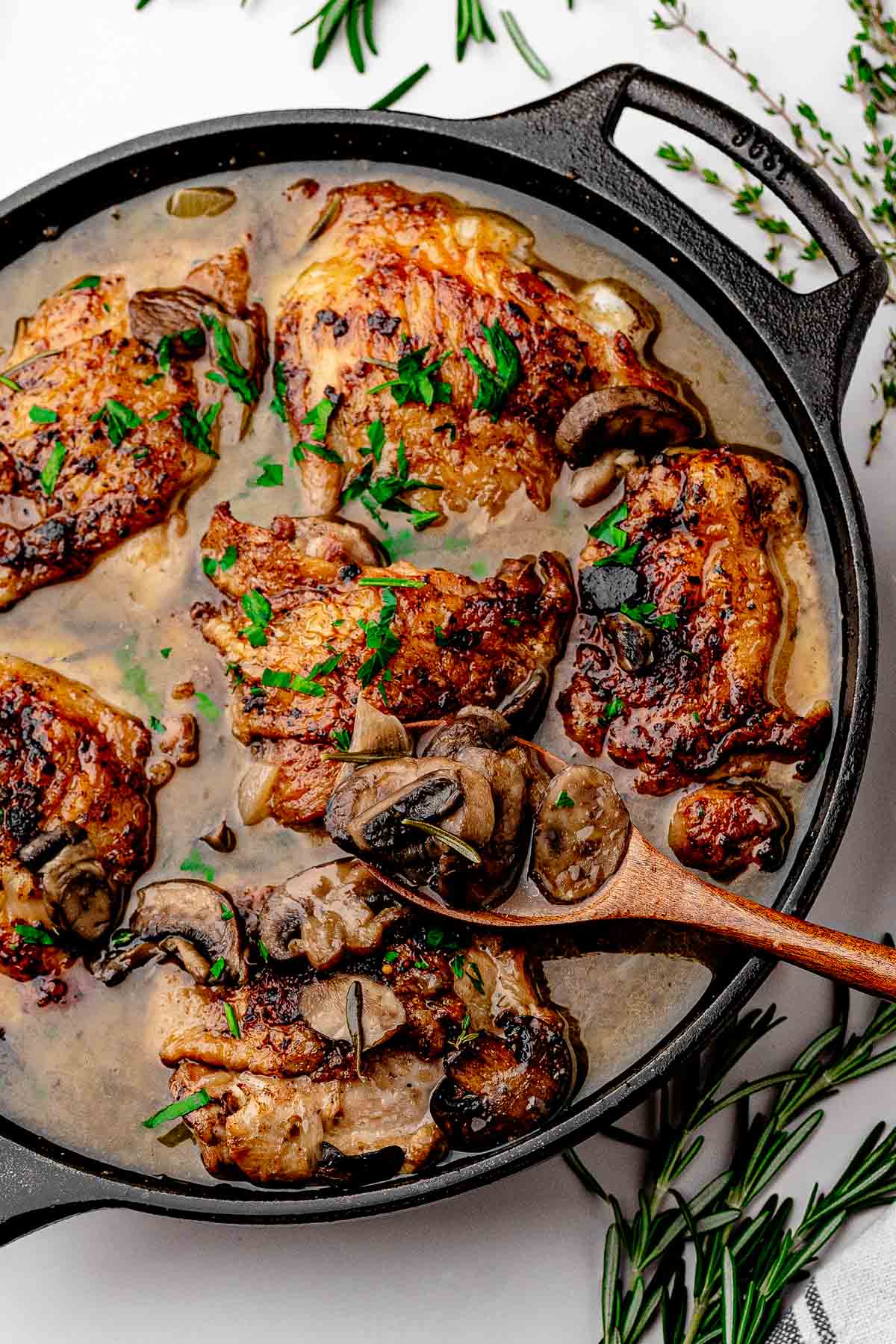
Apple cider braised chicken thighs turn one skillet into a complete fall dinner. Bone-in, skin-on thighs sear skin-side down 6-8 minutes until the skin crisps, then braise at 350°F for 35-40 uncovered in fresh cider, chicken broth, and Dijon mustard with cremini mushrooms and shallots until the meat hits that 175-185°F sweet spot.


Why I Love This Recipe
Here's what keeps this one in regular rotation: the sauce basically makes itself. As the chicken braises, the liquid reduces right in the skillet, picking up all the browned bits left from searing, so there's no separate sauce to build beyond a final swirl of butter at the end.
It also works in whatever oven-safe cookware you already own, a regular skillet or a Dutch oven, and takes about 70 minutes start to finish.
It's leftover-friendly, too. I shred what's left into a salad bowl or spoon it over mashed potatoes the next night, and the sauce only gets better as it sits.
If you love comforting chicken thigh recipes, try my 5-Ingredient Crispy Oven Baked Chicken Thighs or the bacon-packed Chicken Thighs with Bacon and White Wine Sauce.
Why This Braise Works
It's all about just paying attention to temperature, ingredient choice, and one small placement trick.
Why 175-185°F, Not 165°F
I know, 165°F is the number we're all trained to look for with chicken - and that's exactly when it's safe to eat. But if you pull these thighs the second they hit 165°F, you'll end up with meat that's just fine instead of meat that falls off the bone. Thighs are loaded with collagen and connective tissue, and that needs more time and heat to break down into something soft. Let the internal temp climb to 175-185°F and that connective tissue melts away, leaving you with chicken that practically shreds itself with a fork.
Why Fresh Cider Changes the Sauce
Fresh cider carries more natural sugar and body, so it reduces into something glossy and thick instead of thin or watery. Shelf-stable apple juice is filtered and pasteurized differently, and it just won't reduce the same way; the sauce ends up flatter and less concentrated. Apple cider is also where the sauce gets its flavor without any extra steps, since it's simmering right alongside the chicken and soaking up all those browned bits from the pan. Cider shows up a lot in my braises for this exact reason - try my Apple Cider Pot Roast and Apple Cider Pork Chops to use up your leftover cider.

Why the Skin Stays Above the Liquid
Here's a small detail that makes a big difference: once the chicken goes back into the skillet, keep that skin sitting above the braising liquid, not submerged in it. If the skin sits in the liquid the whole time, it turns soft and rubbery - nobody wants that. Keeping it above the liquid line means the skin you worked so hard to crisp up in step one stays crisp, while the meat underneath still gets fully coated in all that cider-Dijon goodness as it braises. Best of both worlds: crispy top, tender meat, saucy bottom.

Ingredient Notes
Chicken thighs - Bone-in, skin-on, no substitutions here if you can help it. The bone keeps the meat juicy through the long braise, and the skin is what you're crisping up in step one. Boneless thighs work in a pinch, but you'll need to pull them out sooner since they cook faster and dry out easier without the bone.
Kosher salt, black pepper, garlic powder - Just the basics for seasoning the chicken before it hits the pan. Nothing fancy needed, and any all-purpose seasoning blend you like works fine here too.
Olive oil - For searing. You want something with a decent smoke point, so olive oil does the job, but avocado oil or another neutral oil works just as well if that's what you've got.
Cremini mushrooms - My go-to because they have more flavor than white button mushrooms without costing much more. Baby bellas are the same thing, just labeled differently at some stores. If you want something with more depth, shiitake or oyster mushrooms are worth trying, though the flavor shifts a little more toward earthy and less toward mild.
Shallots - Milder and sweeter than a regular onion, which matters here since they're cooking down slowly and you want them to caramelize, not overpower the sauce. Pearl onions are the closest swap if shallots aren't available.
Garlic cloves - Fresh, not the jarred stuff, if you can manage it. It only cooks for a minute, so you want that sharper, fresher flavor rather than something already mellowed out.
Fresh apple cider - This is the one ingredient I wouldn't swap. Fresh cider has more natural sugar and body than shelf-stable apple juice, and it's what lets the sauce reduce into something glossy instead of thin. If you can only find hard apple cider, the dry version works too and gives the sauce a slightly deeper, less sweet edge.
Chicken broth - Rounds out the braising liquid and keeps the sauce from being too sweet on its own. Low-sodium is what I use so I can control the salt level at the end.
Dijon mustard - Adds a little sharpness that balances the sweetness from the cider. Whole grain mustard works as a swap if you want more texture in the sauce, but skip yellow mustard here, it's too mild to do the same job.
Apple cider vinegar - A small splash to brighten the whole sauce right before it goes into the oven. White wine vinegar is a fine substitute if that's what's in your pantry.
Fresh thyme and rosemary - These simmer right in the sauce and get pulled out before serving, so they're doing background flavor work rather than showing up in the final dish. Dried herbs work if fresh isn't available, just use about a third of the amount since dried herbs are more concentrated.
Unsalted butter - Stirred in at the very end to make the sauce glossy and rich. Using unsalted means you're controlling the salt level yourself instead of guessing how salty a salted butter might be.
Fresh parsley - For garnish, mostly for color and a little freshness on top. Chopped fresh thyme works too if you want to keep the herb flavor consistent with what's already in the sauce.

How to Make Apple Cider Braised Chicken Thighs
Step 1: Sear the Chicken
Pat the chicken thighs completely dry first. Wet skin steams instead of browning, and you want that deep golden crust, not a pale, soft one. Season both sides with salt, pepper, and garlic powder, then get your skillet hot enough that the oil actually shimmers before the chicken goes in.


Lay the thighs skin-side down and leave them alone for 6-8 minutes. I know it's tempting to move them around, but don't. The skin needs that uninterrupted contact with the pan to crisp properly. Flip for another 2 minutes, then pull the chicken out onto a plate. It won't be fully cooked yet, and that's fine - it finishes in the oven.


Step 2: Build the Sauce Base
Drop the heat to medium and add your mushrooms to the same skillet, right into the fat left behind from the chicken. Give them room to spread out so they brown instead of steaming, about 6-7 minutes. Stir in the shallots next and let them soften for a few minutes, then add the garlic for one more minute, just until it smells good.


Pour in the apple cider and scrape up every browned bit stuck to the bottom of the pan - that's where a lot of the flavor is hiding. Stir in the chicken broth, Dijon, and apple cider vinegar, then tuck in the thyme and rosemary.


Step 3: Braise Uncovered in the Oven
Nestle the chicken back into the skillet, skin-side up, and bring everything to a gentle simmer on the stovetop before it goes into the oven. This part matters: leave the lid off. I've tried covering it to speed things up, and the skin turns soft every time - not worth it. Braise uncovered for 35-40 minutes. I check the internal temp with a thermometer rather than guessing by eye, since thigh sizes vary more than you'd expect. You're looking for 175-185°F, which is higher than the 165°F safe minimum but where the meat actually turns tender enough to pull apart.
Step 4: Finish the Sauce
Once the chicken's out of the oven, fish out the herb stems - they've done their job. Stir the butter into the sauce right in the skillet until it turns glossy.


Taste it before you serve; some batches of cider are sweeter than others, so you might want a touch more salt or pepper to balance it out. Let the chicken rest for about 5 minutes before you dig in. Skipping that step and cutting in right away just means more juice ends up on the cutting board instead of in the meat.
Once they rest, it's time to serve chicken dinner!

Apple Cider Braised Chicken Thighs with Mushrooms and Shallots
Equipment
- Large oven-safe skillet or Dutch oven
- Tongs
- Measuring cups
- Measuring spoons
- cutting board
- Chef's knife
- Wooden spoon
- Instant-read thermometer
Ingredients
For the Chicken
- 6 bone-in skin-on chicken thighs
- 2 teaspoons kosher salt
- 1 teaspoon black pepper
- 1 teaspoon garlic powder
- 2 tablespoons olive oil
For the Braise
- 8 ounces cremini mushrooms halved
- 3 medium shallots sliced
- 4 garlic cloves minced
- 1 ½ cups fresh apple cider
- ½ cup chicken broth
- 1 tablespoon Dijon mustard
- 1 tablespoon apple cider vinegar
- 4 sprigs fresh thyme
- 2 sprigs fresh rosemary
To Finish
- 2 tablespoons unsalted butter
- Fresh chopped parsley for garnish
Instructions
- Preheat the oven to 350°F.
- Pat the chicken thighs completely dry with paper towels, then season both sides with salt, pepper, and garlic powder.
- Warm the olive oil in a large oven-safe skillet over medium-high heat until shimmering.
- Lay the chicken skin-side down in the skillet and cook undisturbed for 6-8 minutes, until the skin is golden and crisp. Work in batches if the thighs don't fit with space between them, since crowding traps steam and prevents the skin from crisping.
- Flip the chicken and cook for another 2 minutes, then transfer to a plate.
- Reduce the heat to medium. Add the mushrooms to the skillet and cook until browned, about 6-7 minutes.
- Stir in the shallots and cook until softened, about 3-4 minutes.
- Add the garlic and cook for another minute, until fragrant.
- Pour in the apple cider, scraping up the browned bits from the bottom of the pan.
- Stir in the chicken broth, Dijon mustard, and apple cider vinegar.
- Add the thyme and rosemary sprigs.
- Return the chicken to the skillet, skin-side up, and bring the liquid to a gentle simmer.
- Transfer the skillet to the oven and braise uncovered for 35-40 minutes, until the chicken reaches an internal temperature of 175-185°F and is very tender. If the skin starts browning too fast, tent that area loosely with foil for the last 10-15 minutes.
- Remove the skillet from the oven and discard the herb stems.
- Stir the butter into the sauce until melted and glossy.
- Taste the sauce and adjust with additional salt and pepper if needed.
- Let the chicken rest for 5 minutes, then garnish with chopped parsley and serve immediately.
Notes
Tips for the Best Braised Chicken Thighs
Here's the thing about the skin: if you rush the sear, no amount of oven time will fix it. Give it the full 6-8 minutes undisturbed and don't peek.
Don't crowd the mushrooms. Give mushrooms space when searing them, even if it means doing them in two batches.
Sear chicken in batches as well if your skillet is on the smaller side. Crowding the chicken thighs traps steam around the skin instead of letting it dry out and crisp, so if all six thighs don't fit with space between them, sear in two batches rather than piling them in at once.
Fresh apple cider, not the shelf-stable jugs. I've made this with regular apple juice in a pinch, and it's not enough - the sauce comes out thinner and one-note instead of rich.
Use a thermometer instead of guessing by time alone. I check mine every time now, because thigh size varies enough that "35-40 minutes" can be off by 5-10 minutes either way.
Keep the chicken skin above the liquid the whole time it's braising. If it dips under, even briefly, you'll lose the crispness you worked for in step one.
Let it rest before serving. Five minutes, that's it, but skip it and you'll watch the juices run right out onto the board.
What to Serve with Braised Chicken Thighs
Mashed potatoes are my default here, because that sauce needs something to soak into. Buttered egg noodles do the same job if you want something a little lighter. Parmesan polenta is my pick when I'm having people over, since it feels a little more special without any extra effort on my part.
For vegetables, I'll usually roast something on the side while the chicken braises, since the oven's already on anyway. Brussels sprouts, honey-glazed carrots, or Spaghetti Squash all work. A loaf of crusty bread isn't a bad idea either, for the same reason as the potatoes: you want something to catch the sauce.
Storage and Reheating Instructions
Leftovers keep in an airtight container in the fridge for up to 4 days. I've frozen this one too, chicken and sauce together, and it holds up fine for up to 3 months. Thaw it in the fridge overnight rather than on the counter.
To reheat, warm it gently in a covered skillet over medium-low heat until it's heated through. The sauce tends to thicken up in the fridge, so I add a splash of chicken broth while it reheats to loosen it back up.
Make-Ahead Instructions
You can brown the chicken and put the sauce together a day ahead, then refrigerate both separately. The next day, just nestle the chicken back into the sauce and braise as directed. I do this a lot on weekends when I want dinner on the table fast on a weeknight.
Frequently Asked Questions
Why Are Chicken Thighs Better for Braising Than Breasts?
Thighs have more fat and connective tissue than breasts, and that's exactly what a long braise needs. Breasts dry out under this kind of heat because they don't have the same fat content to protect them. I've swapped breasts in before out of curiosity, and the texture just isn't the same - it comes out fine, not fall-apart tender.
What Type of Mushrooms Work Best?
Cremini is what I use the most, since they've got more flavor than white button mushrooms for close to the same price. White button mushrooms still work if that's what's fresh in your store. If you want to go a step further, shiitake or oyster mushrooms bring more oomph in my opinion.
Can I Add Potatoes or Other Vegetables?
Yes, and I do this often when I want a more complete one-pan meal. Baby potatoes, carrots, parsnips, or chunks of butternut squash all work well. Add them in before the skillet goes into the oven so they have enough time to cook through alongside the chicken.
Why Is My Braising Sauce Too Thin?
The sauce should thicken as it reduces in the oven, but if it's still thin once the chicken's done, pull the chicken out and simmer the sauce alone on the stovetop for 5-10 minutes. That extra bit of reduction time makes a bigger difference than you'd expect. A properly melted swirl of butter at the end helps too, since it gives the sauce body without any extra cooking time.
How Do I Know When Braised Chicken Thighs Are Done?
Chicken is technically safe at 165°F, but for this recipe, you want it higher. Braised chicken thighs are at their best once they've had enough time in the oven for the connective tissue to break down properly.
What Can I Do with Leftovers?
More than you'd think. I've shredded leftover chicken into pasta, spooned it over creamy risotto, and piled it into sandwiches the next day. The sauce is worth saving too - I've used it as a base for a quick gravy over rice when I didn't feel like cooking anything new.
Can I Make This in a Dutch Oven?
Yes, and it might even be a better fit than a skillet if you have one. A Dutch oven holds heat more evenly, so the braise cooks a little more consistently from edge to center.
Can I Use Boneless Chicken Thighs?
You can, but keep a closer eye on the clock. Boneless thighs cook faster since there's no bone slowing down the heat, so start checking for doneness earlier than you would with bone-in.

More Cozy Chicken Dinners to Try
If this apple cider braise won you over, a few other chicken thigh dinners in a similar vein are worth bookmarking. This herb roasted chicken in a creamy white wine pan sauce leans on the same one-pan logic but swaps cider for wine and cream for the sauce base.
For something with a little smoky richness, try baked chicken thighs with bacon in white wine sauce - the bacon fat does a lot of the same flavor-building work the rendered chicken skin does here.
And if mushrooms are the part of this recipe you keep coming back to, creamy mushroom chicken thighs puts them front and center in a skillet sauce instead of sharing the spotlight with cider and shallots.

Comments
No Comments