
A tall layer cake is only impressive if it stands up straight instead of slowly tilting, sliding, or splitting. The good news? You don't need fancy bakery gear to get there - just a smart stacking routine. Learn how to level your layers, control your filling, chill at the right moments, and add simple support so your cakes slice cleanly, travel safely, and look as good as they taste.

Layer Cakes Look Hard. The Real Work Happens Before You Ever Touch the Frosting.
You baked a beautiful cake. The layers are done, the frosting is ready, and you're feeling confident. Then you start stacking and suddenly - it leans. It slides. One layer is thicker than the other. The filling is oozing out the sides. Sound familiar? You're not alone. Stacking cake layers is one of those skills that looks simple until you're actually doing it, and it all starts with one thing: never stack a warm cake.
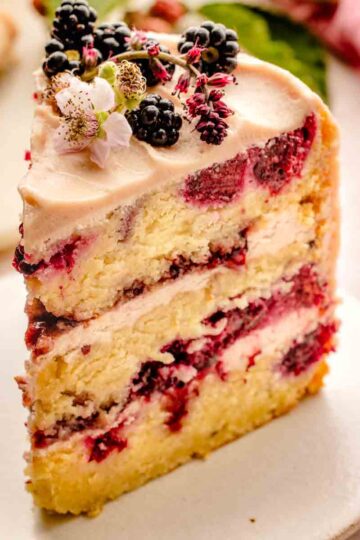
Whether it's a classic chocolate cake, or show-stopping white chocolate raspberry cake (pictured below), the stacking rules are the same. A few smart habits are all that stand between you and a tall, straight, bakery‑worthy layer cake. No fancy equipment required - just technique, patience, and a fridge you're not afraid to use. Here are 10 tips that will change how you stack cakes forever.

Cake Layer Checklist (So Your Layers Don't Slide or Sink)
- ✅ Bake flatter layers with lower heat and pan strips
- ✅ Level every dome before stacking
- ✅ Chill layers completely - cold is always better
- ✅ Chill your fillings before they go between layers
- ✅ Pipe a buttercream dam on every layer
- ✅ Try a cake ring for tall or soft-sponge cakes
- ✅ Flip the top layer upside down for a flat finish
- ✅ Chill partway through stacking on tall cakes
- ✅ Use straws or dowels for very tall or tiered cakes
- ✅ Always crumb coat, chill, then apply final frosting
If you're new to stacking and frosting cakes, my full Layer Cake Guide walks you through every step. And if you're using reverse creaming for your layers - or thinking about it - Reverse Creaming Do's and Don'ts: Why Cakes Turn Dense and How to Fix It covers exactly what to do, what to avoid, and the flour fix most recipes skip.
Layers vs. Tiers (Know What You're Building)
Before we start, I want to clarify what I mean by stacking layers or building tiers.
- Layers: Multiple slices of cake and filling that form a single cake (for example, three 8‑inch layers in one tall cake). See Triple Layer Chocolate Cake for an example of a 3 layer cake below.
- Tiers: Separate cakes (each on its own board) stacked on top of each other, like a 6‑inch cake sitting on top of an 8‑inch cake. Examples are wedding cakes.
Most of us, home bakers, are dealing with layers, not true tiered wedding‑style cakes. Layers rely on chilling, even filling, and optional light support; tiers always require cake boards and robust dowels

Tip 1: Bake Flatter Cakes From the Start
The easiest stacking problem to solve is the one that never happens. If your cakes come out of the oven with a massive dome every single time, you're fighting an uphill battle before you've even picked up a knife.
Try baking at a slightly lower temperature for a longer time. Use cake pan strips - those wet fabric strips you wrap around the outside of the pan - to slow down the edges so the whole cake rises more evenly. And make sure you're not overfilling the pan. Flat layers are a choice you make before the oven timer goes off. Case in point: Berry Chantilly Cake.

Tip 2: Always, Always Level Your Layers
Here's a hard truth: no two layers are ever perfectly identical straight out of the oven. Domes happen. Uneven rises happen. And if you stack domed layers on top of each other, you're basically building a wobble sandwich.
Grab a long serrated knife and a turntable. Score all the way around the dome at the height you want, rotating the cake as you go, then follow that guideline with a full cut. If you want to go even lower-tech, stick toothpicks around the cake at a consistent height and use them as a cutting guide. Either way, flat tops aren't optional - they're the foundation of everything that comes next.

Tip 3: Cold Cake Is Your Best Friend
This is the tip most home bakers skip, and it's the one that makes the biggest difference. Warm cake is soft, crumbly, and cooperative in all the wrong ways. It tears when you spread frosting on it. It shifts when you set another layer on top. It basically refuses to stay where you put it.
Cool your layers completely at room temperature first, then wrap them and pop them in the fridge for at least an hour - or overnight. Some bakers lightly freeze them. A cold, firm cake handles like a dream: easier to level, easier to stack, and infinitely easier to frost without crumbs going everywhere.
Pro tip for beginners: Don't even think about stacking until your layers are completely cool. Any leftover warmth will melt your frosting from the inside out. If you can, bake the layers a day ahead and chill them in the fridge in an airtight container - they'll be easier to level, easier to stack, and way less likely to slide.

Tip 4: Chill Your Fillings Too
You went to the trouble of chilling your cake layers - don't undo all that work with a runny filling. Pastry cream, lemon curd, fruit compote, mousse fillings - all of these need to be thick and cold before they go between layers. Room-temperature mousse will slide. Warm curd will seep. Neither is recoverable once the cake is stacked.
If a filling seems too loose even when cold, pipe a thick buttercream dam around the edge before spooning it in. Which brings us to...

Tip 5: Always Pipe a Buttercream Dam
This is one of those techniques that sounds a little extra until the first time you skip it and your raspberry jam shows up on the outside of your cake. A frosting dam is simply a ring of stiff buttercream piped around the inside edge of each layer before the filling goes in. Think of it as a little wall that keeps everything where it belongs.
Fill inside the dam, spread level, and then add your next layer. The dam prevents bulging, keeps the sides of your cake looking clean, and stops softer fillings from destabilizing the whole structure. This step takes 30 seconds and saves endless frustration.

Tip 6: Try a Cake Ring for Perfect Straight Sides
If you've ever wondered how bakeries get those incredibly straight, sharp-edged layer cakes, here's the secret: they often build them inside a cake ring or acetate-lined pan. You place the ring on a board and stack your entire cake inside it - layers, filling, and all - then refrigerate the whole thing until it's set firm. When you lift the ring off, the sides of the cake are perfectly straight.
This is especially helpful for tall, narrow cakes (like a 6-inch four-layer cake), for very soft sponge cakes, or for impressive mousse-filled layer cakes that need structural help while they set. It's not essential for every bake, but once you try it, you'll wonder why you ever stacked any other way.
Tip 7: Flip That Top Layer Upside Down
Here's a quick professional trick that takes zero extra effort: place your final top layer upside down. The flat bottom of the cake becomes the top of your stack, giving you a naturally flat, smooth surface for frosting without any trimming.
For two-layer cakes, try pressing the two flat bottoms together in the center with frosting as the glue. The bottoms of most cakes are the most level surfaces available, so using them strategically means less leveling work overall.

Tip 8: Chill Between Layers as You Go
If you're stacking more than two or three layers, stop partway through and refrigerate the cake for 20 to 30 minutes before continuing. This is especially important with soft fillings, warm kitchens, or soft cake varieties like chiffon or red velvet.
A partially built cake that's been chilled is dramatically more stable than one assembled all at once in a warm kitchen. The frosting firms up, the filling sets, and the whole structure tightens before you ask more of it. Think of it as letting the cake "grip" itself before you keep going.

Tip 9: Use Straws or Dowels for Very Tall or Tiered Cakes
For a standard 8-inch, two or three-layer cake, such as this Lemon Raspberry Cake pictured below - you probably don't need internal supports at all if you chill properly and use a firm filling. But for tall, narrow cakes, very soft cakes, or anything that involves one separate cake sitting on top of another (which is technically a tiered cake, not a layer cake), supports are non-negotiable.
Boba straws or thick smoothie straws work brilliantly for home bakers - they're sturdy, easy to cut with scissors, and push in cleanly. Insert them straight down into the cake until they hit the board, mark the height, trim, and re-insert so the tops sit flush with the surface. A few straws arranged in a ring pattern inside the footprint of the upper tier will carry the weight and prevent sinking. For any true tiered structure, each separate cake should sit on its own cake board, and the tier below needs adequate dowel support before the upper cake ever touches it.

Tip 10: Crumb Coat, Chill, Then Finish
What is a crumb coat? A crumb coat is a very thin layer of frosting applied to a cake to seal in loose crumbs, fill gaps, and provide a smooth, stable base for the final, thicker layer of icing. It acts as a primer, ensuring the final, decorated surface is clean, smooth, and free of mixed-in crumbs.

You've stacked perfectly. Don't rush the finish line. Apply a thin crumb coat - a lean, rough layer of frosting over the whole cake - that seals in all the crumbs, fills in minor gaps between layers, and creates a smooth base for your final coat. Then refrigerate the cake again until the crumb coat is completely firm.
This extra chill is where the cake becomes the version of itself you imagined when you started. The structure locks in. The layers are fused together by cold, firm frosting. And when you go in with your final coat and a bench scraper, you're working against a solid, stable base - not a soft, shifting one. Take your time, use a turntable, check the sides from eye level, and clean up your edges. You've done the hard work. This last step is just the finish.
Build Your Layer Cake Knowledge
These are the recipes and techniques I have collected over the years of baking so that I can quickly come back to them when needed - I tested them extensively and linked all of them here so you can go as deep as you want whenever you need to.
The Technique Guides
These are the foundational steps I cover in this guide, each with its own deep-dive page if you want the full detail:
- What Is a Cake Dam and Why Every Layer Cake Needs One - The 90-second step that keeps soft fillings exactly where you put them. Essential for fruit-filled cakes.
- How to Crumb Coat a Cake - The thin first layer most home bakers skip - and why skipping it shows up in the final result.
- How to Dependably Build a Layer Cake
- How to Make Vanilla Layer Cake (and Why the Creaming Step Changes Everything)
- Ultimate Guide to Chocolate Frosting - Buttercream, ganache, fudge-style, and more - how to pick the right one for the right cake.
The Layer Cakes Worth Making
Each of these uses at least one technique from this guide. They're ordered from most beginner-friendly to most involved:
- Moist Triple Layer Chocolate Cake - One bowl, oil-based batter, stays moist for days. A reliable first layer cake if you've never made one.
- Moist Lemon Blueberry Layer Cake - Bright, fruit-forward, and the cake that taught me why a cake dam is non-negotiable with berry fillings.
- Chocolate Strawberry Cake - Three layers, from scratch, with fresh strawberry filling. One of the most requested on this site.
- Raspberry White Chocolate Layer Cake - The most bakery-style cake I make at home. Freeze-dried raspberry buttercream, white chocolate layers, clean slices.
- Berry Chantilly Cake - Reverse-creamed layers with mascarpone frosting. Lighter than a classic buttercream cake and better than most bakery versions I've tried.
- Vanilla Blueberry Layer Cake with Frozen Blueberry Filling and Vanilla Bean Buttercream
Comments
No Comments