

If you've ever watched a seasoned cook confidently dump what looks like a shocking amount of salt into boiling water, you weren't imagining it - that generous handful is the real secret to great pasta. Most home cooks dramatically undersalt their pasta water, and the difference it makes is everything.

For years, every pasta recipe I read said the same thing: "Salt the water until it tastes like the sea."
The problem? My idea of "the sea" changed depending on the day, my mood, and whether I'd just eaten something salty. Some nights the pasta came out perfect. Other nights, my sauce was great but the whole dish veered into "wow, that's salty" territory, especially once I started finishing pasta in the pan with starchy pasta water.
At some point I got tired of guessing and started treating pasta water the way I treat baking formulas: with actual ratios, real measurements, and a simple taste test I can repeat.
The 1% Rule
The golden standard in professional kitchens is simple: aim for 1% salt by weight. That means for every liter (roughly 1 quart) of water, you want about 10 grams of salt (roughly ½ to 1 tablespoon, depending on how fine or flaky your salt is - see the breakdown below). So if you're cooking a full pound of pasta in 3 liters of water, you're looking at around 30 grams of salt (roughly 1½ to 3 tablespoons, again depending on your salt - see the chart below)- and yes, that's more than you think. The pasta absorbs only a fraction of it; the rest goes right down the drain.
No scale? Here's how that translates by salt type, since crystal size changes how much volume you need for the same weight:
| Salt type | Per 1 liter/quart water | Per 3 liters (1 lb pasta) |
|---|---|---|
| Table salt | ~1½ teaspoon (½ Tbsp) | ~1½–2 Tbsp |
| Morton kosher salt | ~½ Tbsp | ~2 Tbsp |
| Diamond Crystal kosher salt | ~1 Tbsp | ~3 Tbsp |
The fluffier the salt, the more volume you need to hit the same 1% - Diamond Crystal is roughly double the volume of table salt for equal weight, so don't swap salts 1:1 by spoon.
Your pasta water should taste clearly seasoned, not briny. Just don't go overboard chasing the actual ocean: seawater clocks in at around 3.5% salinity, which would make your pasta inedible. Stay in that 1-1.5% sweet spot and you're golden.
Why Salt Brand Changes the Math
Bon Appétit often cites about ¼ cup (4 tablespoons) of kosher salt for 6 quarts of water, which runs a bit lighter than what I've tested and prefer: about 8 to 10 grams of salt per liter (about 6 tablespoons of Diamond Crystal for that same 6 quarts), or about 1% salinity. That keeps the ratio consistent even when the salt brand changes.
My salt measurements are always done with Diamond Crystal kosher salt in mind. Here's the thing - Diamond Crystal is the go-to in professional kitchens precisely because its hollow, pyramid-shaped crystals don't pack tightly, leaving a lot of air in the measuring cup. That means it's roughly half as salty by volume as table salt or denser kosher salts like Morton's. So while ¼ cup might sound like a lot to someone used to a quick pinch, it's actually on the lighter side of my own range - it's calibrated for the salt most chefs actually use. Dig deeper in salt differences here: Kosher Salt vs. Table Salt and Which Salt To Use and When (Table, Kosher, Sea, Himalayan, Flaky, and Celtic).
However you season, just remember the golden rule: you can always add more, but you can never take it back out.
Want to explore the relationship between salt and meat further? Check out this brining method for making pork more flavorful.
Why Kosher Salt
Kosher salt is coarse, irregular flake dissolves beautifully in water, distributes evenly, and unlike table salt, it contains no iodine additives that can subtly affect flavor. Diamond Crystal, in particular, is beloved by chefs and cookbook authors for its lighter texture, quick dissolve, and more forgiving seasoning - it's harder to accidentally over-salt with it.
Why Salting Pasta Water Properly Matters
Pasta water is doing three jobs for me at once:
- It seasons the pasta from the inside out.
- It becomes part of the sauce when I finish the pasta in the pan.
- Its salt level can make or break an otherwise perfect sauce.
If the water is undersalted, I end up chasing the flavor in the pan, dumping in more salt at the end and still feeling like the noodles taste a little flat.
If the water is oversalted and I'm using that same water to emulsify a sauce (like in my How to Emulsify Pasta Sauce with Pasta Water method), the whole dish can skew aggressively salty fast-especially with cheese, bacon, or salty stock in the mix.
So instead of relying on vague advice, I now use a simple baseline ratio plus a taste check that I adjust based on the recipe.
My Baseline Ratio: How Much Salt Per Liter
Let's start with some numbers. For general pasta cooking (not accounting yet for super‑salty sauces), my baseline is:
- About 3 to 4 tablespoons of Diamond Crystal kosher salt per 4 quarts
If you're working in liters and grams, a handy starting point is:
- Roughly 8-10 grams of salt per liter of water
That range gives me water that is clearly seasoned but not briny. It tastes like something I'd be happy to sip a spoonful of-not bland, not seawater.
Because different salts measure differently, I always think in weight when I can, or I stick to one brand of kosher salt so I know how it behaves. If I switch salts, I don't blindly trust the tablespoon; I taste and adjust.
If I'm cooking for people who are sensitive to salt, or I know I'm going heavy on salty ingredients later (bacon, Parmesan, Cajun seasoning), I'll stay at the lower end of that range and lean on the sauce to finish the seasoning.
Step One: Start with Enough Water
Ratios only work if I'm using enough water to begin with.
For long strands like spaghetti, linguine, or fettuccine, I reach for a large pot and use at least:
- 4-5 quarts (about 3.8-4.7 L) of water for a standard 1‑pound (450 g) box of pasta
For short pasta shapes, I can sometimes get away with a bit less, but I don't like to crowd the pot. The pasta needs room to move so it doesn't stick, and I want a decent volume of water for my ratio to make sense.
If you ever wonder how much pasta to cook in the first place, I break that down in detail in my guide on How Much Pasta Per Person. Getting the amount of pasta right makes it easier to keep your water and salt in a consistent range.
Step Two: Add Salt After the Water Boils
I bring the water to a rolling boil first, then add the salt. Two reasons:
- Salt dissolves more quickly and evenly in boiling water.
- It's better for your cookware long‑term to avoid leaving undissolved salt sitting on the bottom of a cold pot.
Once the water is boiling, I stir in my measured salt, taste, and adjust from there.
For a 4‑quart pot, that usually means:
- I start with roughly 3 tablespoons of kosher salt, stir to dissolve, then taste.
- If it's bland, I add another teaspoon or two and taste again.
- If it's already at that "pleasantly seasoned" point (clearly salty but not briny), I stop.
The Taste Check: How I Know It's Right
Here's how I actually taste pasta water without overthinking it.
- I let the salted water come back up to a boil.
- I dip in a small spoon, let it cool for a second (it's hot), and taste.
- I ask myself one question:
- "Would I happily eat something cooked in this, or does it taste like a salt lick?"
I'm aiming for water that tastes a little more seasoned than soup, but less salty than a straight shot of broth from a can.
If the answer is "I can taste the salt clearly, but it doesn't make me pucker," I'm in the right zone.
If I'm planning to:
- Finish the pasta in an already salty sauce, or
- Use a lot of pasta water to emulsify a sauce that's loaded with cheese, bacon, or Cajun seasoning
…then I'll intentionally keep that water just a notch less salty than my normal baseline. I'd rather slightly under‑season the pasta and adjust in the pan than overshoot and not be able to pull it back.
When I Dial the Salt Down
I don't use the exact same pasta‑water salinity for every dish. Some recipes bring their own salt to the party.
I dial the pasta water down a bit when I'm making:
- Creamy, super‑cheesy sauces
For recipes like my Chicken Pasta in Creamy White Wine Parmesan Cheese Sauce, there's plenty of Parmesan and possibly salty stock. I still want seasoned water, but I'll lean closer to 3 tablespoons per 4 quarts mark, not more. - Sauces with bacon, pancetta, or cured meats
In my Chicken Penne with Bacon and Spinach in Creamy Tomato Sauce, the bacon brings salt, the tomato sauce concentrates, and I'm finishing the pasta in the pan with pasta water. This is exactly the kind of recipe where slightly gentler water gives me more control at the end. - Heavily seasoned Cajun or chipotle dishes
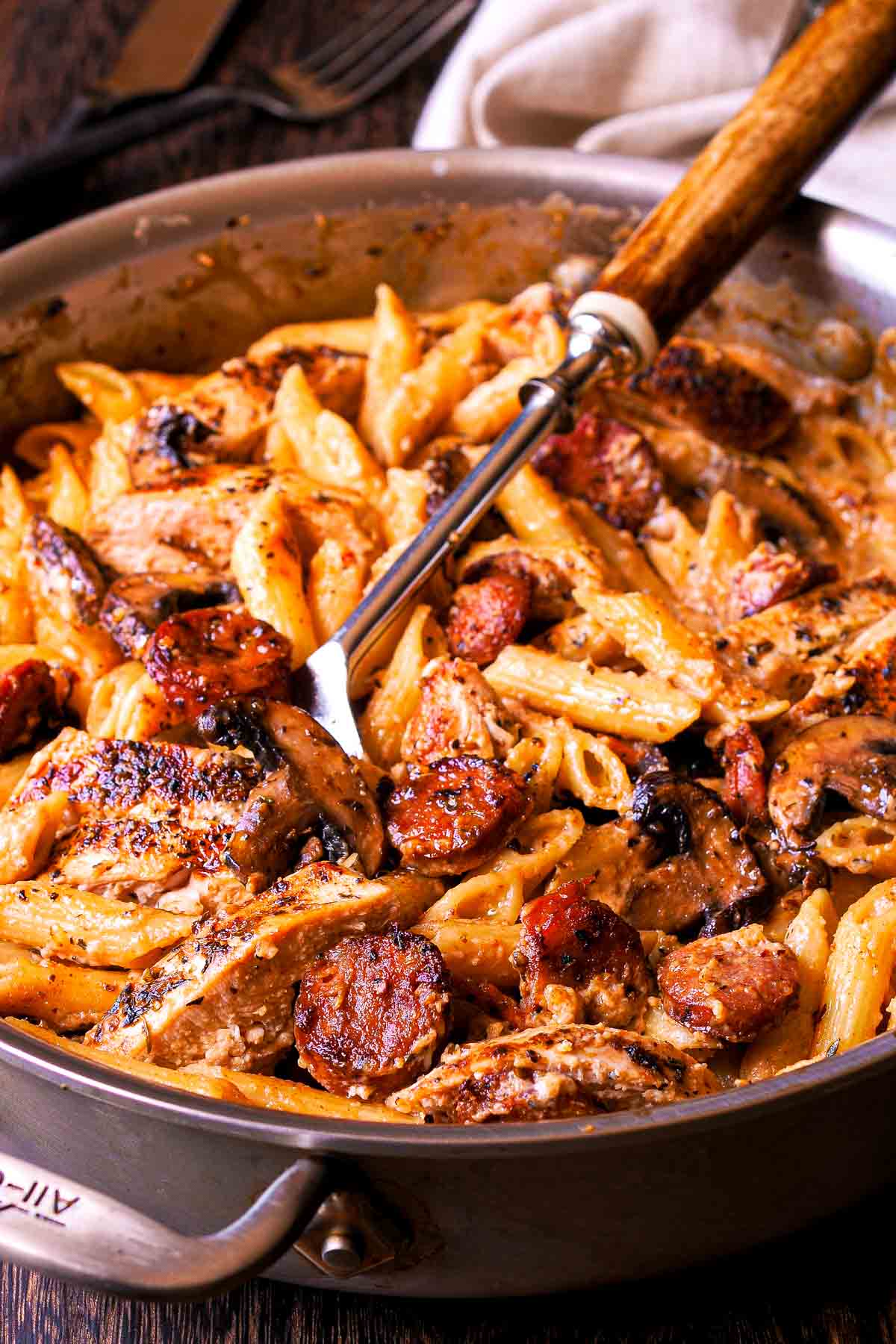
In dishes like my Creamy Chipotle Chicken Pasta (pictured below) or Louisiana Chicken Pasta, there's already a lot of seasoning in the sauce. If I know I'll be adding starchy water to emulsify that sauce, I'll taste the sauce itself first, then keep the pasta water on the lighter side so the two layers of salt don't stack too hard.
The big idea: the salt level in your pasta water should support the whole dish, not just the noodles.

When I Keep the Pasta Water at Full Strength
On the flip side, I don't go shy on salt when:
- The sauce is very simple (just olive oil, garlic, maybe some chili flakes).
- I know I'll be using a fair bit of pasta water to build body and emulsify, but there aren't a lot of inherently salty ingredients.
For example, in my Chicken Pasta with Spinach and Cherry Tomatoes in Wine Cheese Sauce, a good hit of salt in the water helps the pasta itself taste alive against the sweetness of the tomatoes and the acidity of the wine. I still watch the cheese at the end, but if the base of the dish is relatively mild, properly salted water does a lot of heavy lifting.
Salting Water When You Emulsify with Pasta Water
If you're already using my How to Emulsify Pasta Sauce with Pasta Water technique, salting the water correctly becomes even more important.
Here's why:
- That starchy water is going into your sauce, not just down the drain.
- You'll often add it in multiple splashes while the pasta finishes cooking in the pan.
In a dish like my Creamy Cajun Shrimp and Sausage Pasta, where I'm finishing the pasta directly in a smoky, creamy sauce and relying on pasta water to bring everything together, I consciously keep the water at a controlled salt level. I don't want to be afraid of using enough pasta water to create a glossy emulsion because I oversalted the pot.
The workflow is:
- Lightly to moderately salt the pasta water.
- Build a flavorful sauce (with its own salt from stock, cheese, etc.).
- Add undercooked pasta and pasta water to the sauce.
- Taste the sauce at the end and adjust salt there, not by going back to the pot.
Think of pasta water as both a seasoning and a texture tool. You want enough salt to matter, but not so much that it handcuffs you.
Matching Water, Salt, and Doneness
Properly salted water does its best work when you also nail pasta doneness. Undercooked pasta won't absorb seasoning well, and overcooked pasta will taste seasoned but lack that pleasant bite.
I always:
- Aim to cook pasta just shy of al dente in the pot, then
- Finish it to true al dente in the sauce, using pasta water as needed
If you want a deep dive on that timing and texture, I break it down in How to Cook Pasta Al Dente. That guide pairs really well with this one: one covers texture, the other covers seasoning and water.
When I get both right-water salted properly, pasta pulled at the right moment-everything that happens in the pan is easier. The pasta absorbs the sauce, the sauce sticks, and I don't have to overcompensate with salt at the end.
If you want to go deeper into that last part, my full guide on How to Emulsify Pasta Sauce with Pasta Water walks through step‑by‑step photos and troubleshooting.
My Pasta Water Salt Rules
Here's a rule of thumb you can use next time you're at the stove:
- Use 4-5 quarts of water for 1 pound (450 g) of pasta.
- Start with roughly 3 tablespoons of kosher salt per 4 quarts (or about 8-10 g per liter).
- Add salt after the water boils, then taste. Adjust until the water tastes pleasantly salty but not briny.
- Dial the salt down slightly if you're making very salty sauces (lots of Parmesan, bacon, salty stock, Cajun seasoning).
- Keep it at full strength for simpler sauces and lighter dishes where the water plays a big role in seasoning.
- Remember: whatever salt you put in the pot will follow you into the pan when you finish the pasta in the sauce.
The bottom line
Once you get comfortable with this ratio + taste‑check combo, salting pasta water stops being a guessing game and becomes another reliable part of your pasta routine, right alongside choosing the right portion size and hitting perfect al dente every time.
Salt your pasta water generously, taste it before the pasta goes in, and adjust from there. Once you nail that clearly seasoned, well-balanced flavor in your pot, perfectly seasoned pasta becomes effortless every single time.

Elisha says
Your math is badly off. The best I can tell is you seem to think that 4 quarts equal a liter. That’s the only way your math makes sense. But 1 quart equals 1 liter (more or less).