

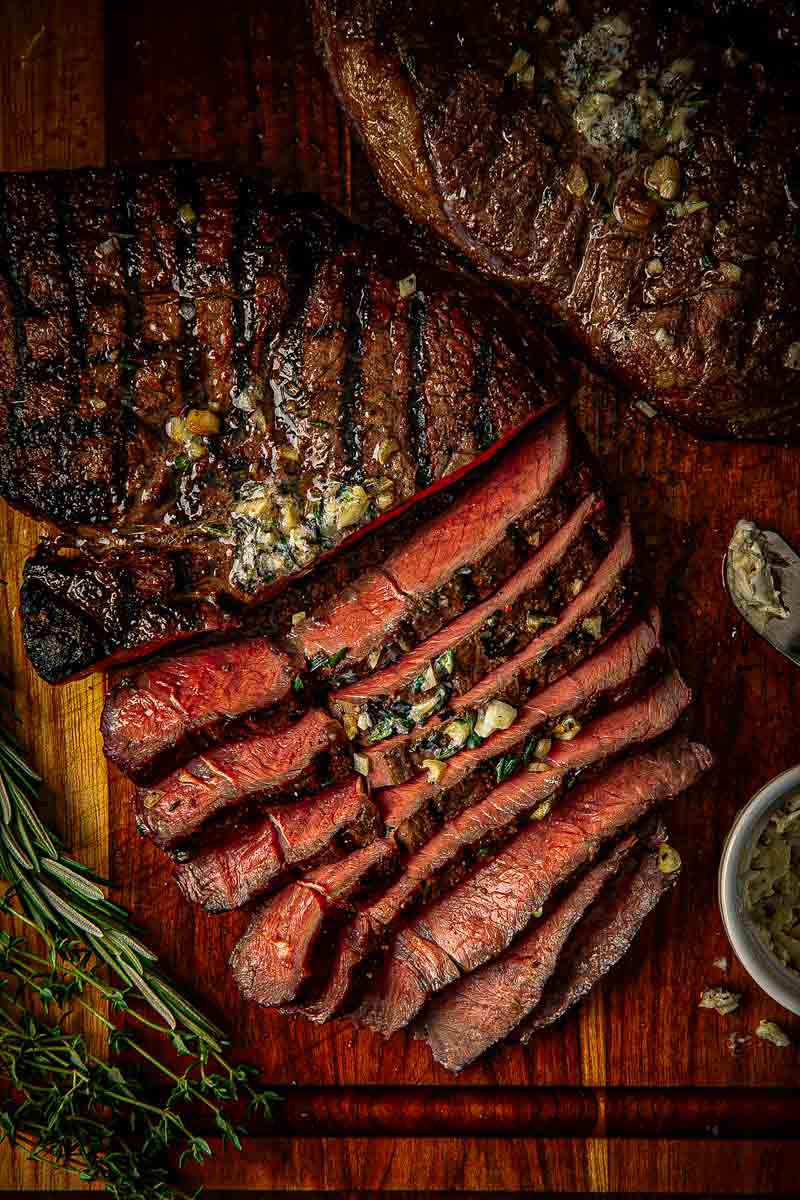
Smoked top sirloin gets a deep crust and a pink center with an overnight dry brine, a 225°F smoke, and a reverse sear at the end. This lean steak cooks fast, so the thermometer matters, and garlic-herb butter at the end turn an affordable steak into something that feels special without being fussy.

My Smoked Sirloin Method
🧂 Dry Brine: Salt your sirloin overnight uncovered in the fridge. This seasons the meat throughout and dries the surface for a better sear.
🔥 The Smoke: Set your smoker to 225°F. Smoke the steak until the internal temperature reaches about 10-15 degrees below your target final temperature (pull around 125°F for a medium-rare finish).
🥩 The Sear: Crank your smoker to high heat, or use a pre-heated cast-iron skillet on the stove, to sear the outside hard and fast.
🧈 The Butter Finish: Top your finished, rested steak with a slice of garlic-herb compound butter.
About This Smoked Top Sirloin Recipe
I've smoked and seared a lot of steaks , but top sirloin is the cut that taught me to slow down (Pan Seared Sirloin Steak is the prime example of that). It's leaner than ribeye or Chuck Roast, so there's very little fat to save you if you overcook it-go about ten degrees too far and it turns chewy instead of tender.
That's the problem reverse sear solves. I let the smoke do the slow work first, bringing the inside up gently so the muscle fibers relax instead of tightening under sudden heat. Only once the center is nearly there do I hit it with real heat, just long enough to build a crust worth writing home about.
If you've ever pulled a steak off the grill and felt like the outside and inside were fighting each other - over on the edges, still cool in the middle - this method fixes that. The smoke stage and the sear stage each get to do their own job, and the steak ends up better for it on both ends.

How the Overnight Dry Brine Changes Browning and Flavor
The dry brine does two things at once: it seasons the steak all the way through and it dries the surface. Salt on the outside pulls moisture up, dissolves, and then moves back into the meat over several hours, so the interior tastes properly seasoned instead of bland. At the same time, the surface dries out in the fridge, and a dry surface browns fast and evenly when it hits hot grates. I've cooked sirloin with and without a dry brine, and the brined version consistently has a thicker, better-tasting crust.
Why Lean Sirloin Needs Low-and-Slow Before High Heat
Sirloin doesn't have the same fat cushion as ribeye or strip, so sudden high heat pushes the exterior past done before the center has a chance to catch up. Starting at 225°F lets the internal temperature climb gradually and gives smoke time to work its way in without tightening the meat. When the steak finally sees high heat, it's already close to medium-rare inside, so the sear is about crust, not cooking it through.
Best Steak Cuts and Thickness for Reverse Sear
Reverse sear works best on steaks thick enough to spend time in the smoker without overcooking. For this method, thickness matters more than the exact weight or the name of the cut. If you give the low-and-slow phase room to do its job, the high-heat finish can be short and controlled.
If you're deciding whether top sirloin is the right cut for your budget or your occasion, 6 Cheap Beef Cuts That Taste Better Than Ribeye breaks down where sirloin sits relative to other affordable options worth knowing about.
Ideal Thickness for Smoked Top Sirloin Steaks
For smoked top sirloin, I aim for steaks between 1 ½ and 2 inches thick. That gives enough time at 225°F for smoke to penetrate and for the center to warm gradually without racing past your target. Thinner steaks rush through the smoke stage and are much harder to keep at medium-rare once you start searing. If my steaks aren't perfectly even, I treat the thinnest one as the "timer" and check all of them off that internal temperature.
Using Strip or Ribeye with the Same Method
Strip and ribeye both take well to the same reverse-sear approach, they just behave a little differently because of the extra fat. The smoke phase is identical: low heat, gentle climb in temperature, then a hot finish. The difference is that ribeye and strip are slightly more forgiving if you overdo the sear, since the fat keeps them juicy longer. When I swap sirloin for strip or ribeye, I keep the smoke-to-sear pattern the same and mainly adjust the final pull temperature based on how done I want them, knowing I have more wiggle room than I do with a lean sirloin.

Wood, Pellet Grill Setup, and Pit Boss Notes
Pellet grills make reverse-sear smoked sirloin more approachable because they hold 225°F with very little effort, but the details still matter. I run my Pit Boss 700FB2 at a true 225°F for the smoke phase and give it plenty of time to stabilize before the steaks go on. Thin, clean smoke is the goal here-if the smoke looks thick and white, I wait for it to settle before putting the meat on. When it's time to sear, I take the preheat just as seriously and let the grill sit at max temp long enough that the grates feel properly fierce when I lay the steaks down.
Interested in learning more about pellet grills? Here's Why the Pellet Smoker Gives You the Most Hands-Off BBQ Experience.
Oak vs Cherry Wood for Smoked Sirloin
For sirloin, I prefer wood that supports the beef flavor instead of drowning it out. Oak gives a medium-bodied smoke that feels classic on steak-noticeable, but not so strong that it hides the taste of the meat. Cherry is softer and slightly sweeter, and it adds a deeper mahogany color to the exterior, which looks great once the crust forms. I always go for oak when I want that traditional steakhouse profile, and cherry when I'm after a milder smoke and a darker, more polished crust. Both work; it's mainly a matter of how assertive you want the smoke to be. Here's more on various types of wood in Wood Guide For Smoking Meat
What to Do When Your Pellet Grill Won't Get Hot Enough
Not every pellet grill will hit the kind of searing temperatures you see in steakhouse kitchens, and I've run into that with my own setup. If the grill stalls in the low 400s, I treat the smoke phase the same and simply move the sear to a ripping-hot cast iron skillet on a gas burner. The steaks come off the smoker at 100°F internal, go into a thin layer of oil in the skillet, and get flipped often while I watch the temperature closely. It's the same reverse-sear logic, just using the hottest tool I have. The important thing is that the high-heat step stays short and focused on crust, not cooking the steak all the way through.
Garlic-Herb Compound Butter for Steak
The garlic-herb compound butter is more than a garnish-it finishes the steak in a way that pulls the smoke and crust together. I mix softened butter with fresh rosemary, thyme, garlic, salt, and pepper, then chill it in a log so it's easy to slice. A round goes on each steak as soon as it leaves the grill, and it slowly melts over the crust while the meat rests. By the time I'm ready to slice, the butter has turned into a seasoned glaze that clings to the surface and runs into the sliced edges.I've tried skipping the butter and just serving the steak plain, and the difference in depth and finish is noticeable enough that I now treat the butter as part of the recipe, not a luxury. If you are interested in learning more about butter and beef, here's How Do You Sear and Baste a Steak Without Burning the Butter.

Simple Variations Like Cowboy Butter or Chimichurri
Once you're happy with the base method, the butter is an easy place to play. A cowboy butter version swaps in Dijon, lemon juice, chives, and a pinch of chili flakes for a sharper, more lively finish that wakes up the smoke and char. Chimichurri takes it in a different direction-parsley, garlic, vinegar, and olive oil spooned over the sliced steak instead of butter. I use the same reverse-sear smoked sirloin and simply change what goes on top, which lets me keep the core technique while making the plate feel completely different.
Step-by-Step: Reverse-Sear Smoked Top Sirloin Steaks
1. Overnight Dry Brine
The dry brine is what turns a plain sirloin into a steak that tastes seasoned all the way through. When you salt the steaks and leave them uncovered in the fridge overnight, the salt first pulls moisture to the surface, then dissolves and slowly moves back into the meat. That's why the surface looks dry and slightly tacky when you take them out-most of the free moisture has already evaporated. I don't skip this step with lean cuts; it makes the crust brown faster and gives the interior more flavor.


2. Smoke at 225°F to 100°F Internal
The smoke phase handles two jobs: it sets up the interior and builds a gentle layer of smoke flavor without tightening the meat. Holding the grill at 225°F and letting the steaks climb slowly to around 100°F internal gives the muscle fibers time to relax instead of seizing under sudden high heat. It also gives oak or cherry smoke enough time to work its way into the outer layer of the steak. I treat this as the "relax and flavor" stage-once the internal hits 100°F, the steak is primed for a quick, aggressive sear.


3. Crank Heat and Reverse Sear to 125°F
After the low-and-slow part, the job shifts to building a crust without blowing past medium-rare. I crank the grill or move to the hottest tool I have and let it fully preheat so the grates feel brutally hot. The steaks go right over that high heat and get flipped regularly, with the focus on color and texture rather than time. Because the interior is already near target, the sear is short and controlled-just enough to put on a thick, browned crust while nudging the center up to about 125°F.

4. Rest with Compound Butter and Slice
The rest is where the steak settles and the butter does its work. As the steak sits under a loose foil tent, the heat redistributes and the juices move back through the meat instead of rushing out onto the board. A slice of garlic-herb compound butter on top melts slowly over the crust, adding richness, browned milk solids, and fresh herb flavor that seeps into the sliced edges. I always wait the full rest before cutting against the grain; it's the difference between a steak that looks juicy and one that actually eats that way.


Reverse-Sear Smoked Top Sirloin Steaks
Equipment
- Pellet grill (Pit Boss 700FB2 or similar)
- Wire rack
- baking sheet
- Small mixing bowl
- Plastic wrap
- Meat thermometer (wireless probe + instant-read)
- Tongs
- Grill or smoker grates
- cutting board
- Foil
Ingredients
Compound Butter
- 4 tablespoons unsalted butter softened to room temperature
- 2 cloves garlic finely minced
- 1 teaspoon fresh rosemary finely chopped
- 1 teaspoon fresh thyme leaves
- ½ teaspoon kosher salt or heaping ¼ teaspoon table salt
- ¼ teaspoon freshly cracked black pepper
Steaks
- 32 oz top sirloin steaks 1 ½ to 2 inches thick
- 1 tablespoon kosher salt or heaping 1 ½ teaspoons table salt, for dry brine
- 1 tablespoon olive oil or avocado oil for searing
- 1 teaspoon freshly cracked black pepper
- 1 teaspoon garlic powder
Instructions
Dry Brine the Steaks
- Pat the steaks dry with paper towels.
- Sprinkle the kosher salt evenly over all sides of both steaks, including the edges.
- Place the steaks uncovered on a wire rack set over a baking sheet.
- Refrigerate for at least 8 hours or overnight.
- When you pull them out, the surface should look dry and slightly tacky-do not rinse.
Make the Garlic-Herb Compound Butter
- About 30 minutes before cooking, remove the steaks from the refrigerator to take the chill off.
- In a small bowl, combine the softened butter, minced garlic, rosemary, thyme, kosher salt, and freshly cracked black pepper.
- Stir until evenly combined.
- Scoop the butter onto a piece of plastic wrap, roll it into a log, and twist the ends closed.
- Refrigerate until needed (up to 3 days ahead).
Smoke the Steaks at 225°F
- Start your pellet smoker with the lid open until you see a flame in the burn pot, then close the lid and preheat to 225°F.
- Season both sides of the steaks with freshly cracked black pepper and garlic powder (no extra salt needed after the dry brine).
- Place the steaks directly on the smoker grates away from the fire pot, with the thickest ends toward the heat source.
- Insert a wireless meat thermometer probe into the thinnest steak so you can monitor the temperature without lifting the lid.
- Smoke until the internal temperature reaches about 100°F, 45 minutes to 1 hour depending on thickness and smoker temp.
- Let the steaks stay in the low heat-this is what relaxes the muscle fibers and lets smoke penetrate deeply.
Reverse Sear on High Heat
- When the steaks reach 100°F, remove them from the smoker and set them aside on a clean plate.
- Pull the thermometer probe out of the steak.
- Crank your smoker or grill to its maximum temperature (450°F to 500°F or higher) and open the sear plate or sear valve to expose the flames.
- Preheat for at least 10 to 15 minutes until the grates are ripping hot; cold grates will steam instead of sear.
- Drizzle a thin layer of olive oil or avocado oil over both sides of each steak and rub it in lightly.
- Place the steaks on the hottest part of the grates directly over the flames.
- Sear, flipping every 4 to 5 minutes, until the internal temperature reaches 125°F for medium-rare, 8 to 12 minutes total.
- Rotate the steaks slightly with each flip so different areas hit the hottest spots and you build an even, crisscross sear pattern.
- Check the temperature in a few different spots on both steaks and pull them right at 125°F (carryover heat will raise it a few degrees as they rest).
Rest with Compound Butter and Serve
- Transfer the steaks to a clean cutting board.
- Slice one round of compound butter from the log and lay it on top of each steak.
- Tent loosely with foil and let the steaks rest for at least 15 minutes to allow juices to redistribute.
- Slice against the grain and serve immediately.
Troubleshooting and Doneness Options
What to Do If Your Steaks Are Thinner Than 1 Inch
Reverse sear works best on thicker steaks, but you can still use the same idea on thinner sirloin with a few tweaks. If my steaks are under 1 inch, I shorten or skip the smoke phase and treat it more like a gentle preheat: a brief time at 225°F just to pick up a hint of smoke, then a fast sear. The main goal is avoiding overcooking the center while you chase crust. I rely more on an instant-read thermometer and pull the steaks earlier in the sear, knowing they'll carry over a few degrees as they rest.
Adjusting for Medium and Medium-Well Sirloin
Not everyone wants medium-rare, and sirloin can still be good a little more done if you're careful. When I'm cooking for people who prefer medium, I simply let the sear phase run until the internal temperature hits around 130°F, then give the steaks their full rest. For medium-well, I go closer to 140°F, but I accept that sirloin at that point will be noticeably less juicy because of how lean it is. The big rule is the same: decide your target temperature first, then treat it as the signal to pull the steak, not the color on the outside.
Storage, Reheating, and Freezing Smoked Sirloin
Fridge Storage and Gentle Reheating
Smoked sirloin keeps well for a few days if you store it properly. I slice the steak, let it cool, then move it into an airtight container and refrigerate for up to three days. For reheating, I go low and slow to protect the texture-either a covered skillet over medium-low heat with a splash of broth or water, or a 275°F oven with the slices covered in foil. The idea is to warm the meat through without trying to recreate a hard sear; chasing high heat again usually just tightens it and dries it out.
Freezer Tips and Best Texture Window
Freezing works fine as long as you treat it as a short-term solution. I put cooled slices in a zip-top freezer bag, press out as much air as I can, and freeze for up to two months, though I prefer to use them within the first month for the best texture. When I'm ready to use them, I thaw overnight in the fridge and reheat gently using the same skillet or low-oven approach. At that point, I'm more likely to use the steak in tacos, quesadillas, or salads, where any minor change in texture is less noticeable than it would be on a plate of plain slices.
Repurposing Leftovers: Tacos, Quesadillas, Salads
Leftover smoked sirloin is one of those things I'm happy to have in the fridge because it turns into fast meals with very little effort. The smoke and crust are already doing most of the work, so the goal with these ideas is just to add texture, freshness, and a bit of contrast around the meat instead of trying to turn it back into "steak night." If you want a full recipe built around grilled steak and fresh produce rather than a loose leftover idea, Grilled Steak Salad with Corn, Avocado, and Red Wine Vinaigrette is worth bookmarking alongside this one.
Smoked Sirloin Steak Tacos
For tacos, I slice the sirloin thin across the grain and warm it gently in a skillet with a splash of broth or water so it doesn't dry out. Warm a stack of corn or flour tortillas, pile in the steak, then add toppings like pickled red onion, crumbled cotija, and a squeeze of lime. If I have salsa or guacamole on hand, a spoonful on top finishes the tacos without much extra work.
Steak Quesadillas and Breakfast Scrambles
Quesadillas are more about crunch and cheese than anything else. I chop the leftover steak into small pieces, scatter it over one tortilla with shredded cheese, top with another tortilla, and cook in a dry skillet until the outside is crisp and the cheese has melted. For breakfast scrambles, I dice the steak and fold it into softly scrambled eggs with sautéed peppers and onions. Both dishes use the sirloin more like a flavorful add-in, which makes any slight change in texture from reheating much less noticeable.
Smoked Steak Salad for Weeknight Dinners
When I want something lighter, I keep the slices on the thicker side and lay them over a bed of greens like arugula or mixed lettuce. Cherry tomatoes, shaved parmesan, and thinly sliced red onion make a simple base, and I finish it with a bright vinaigrette so the smoke and beefiness don't feel heavy. It still eats like a proper dinner, but the plate feels different enough from the original steak that it doesn't feel like leftovers.

Frequently Asked Questions
You don't have to use top sirloin, but that's the cut this method is built around. Sirloin is lean and can turn chewy fast, so the low-and-slow smoke plus short, fierce sear are calibrated to protect it. Strip and ribeye work very well with the same approach and are actually more forgiving, but if you follow the timings and pull temperatures here, sirloin is where you'll notice the biggest improvement.
You can shorten it, but I wouldn't skip it entirely. Even a few hours in the fridge after salting will start to draw moisture to the surface, dissolve the salt, and pull it back into the meat. The longer rest just gives you more even seasoning and a drier surface for better browning. If I'm pressed for time, I still try to give the steaks at least 2-3 hours; I've cooked both ways and the brined version wins every time.
Most pellet grills wander a bit around the set temperature, and that's fine. If yours drifts between roughly 215°F and 240°F, the method still works; you may just see the internal temperature rise a little faster or slower. I watch the steak's internal temperature more than the display and treat 100°F as my signal to move into the sear, regardless of small swings on the grill. If the grill runs consistently hotter, you can start checking a bit earlier.
The key is using an instant-read thermometer and thinking in terms of pull temperature instead of time. Once the steaks go over high heat, I check them regularly and aim to pull sirloin around 125°F for medium-rare, knowing it will climb a few degrees as it rests. If I'm cooking for people who want medium, I aim for 130°F. I don't wait for a certain number of minutes; I let the thermometer tell me when the crust has done its job and the center is where I want it.
More Meat Smoker Recipes You'll Enjoy
When I want a true low-and-slow project, this is the one I reach for. The brisket cooks gently until it's sliceable and tender, with a bark that can handle plenty of smoke time.
Texas-Style Brisket Flat
This chuck roast gives you that "brisket vibe" on a smaller, more budget-friendly cut. It smokes until it pulls apart easily, so you get all the bark, smoke ring, and juicy shreds without babysitting a huge packer.
Smoked Chuck Roast (Poor Man's Brisket Done Right)
On weeks when I don't want to fuss with a big cut, I love this two-stage smoked chicken. The smoke builds flavor first, then a hotter finish crisps the skin so the meat stays juicy instead of drying out.
Two-Stage Beer Can Smoked Chicken
This smoked pork butt is my go-to for feeding a crowd. It takes on smoke slowly, builds a deep, flavorful crust, and pulls into tender strands that work for sandwiches, tacos, or meal prep through the week.
Smoked Pork Butt (Boston Butt)
More Steak Recipes You'll Love
- How to Cook Sirloin Steak (Pan-Seared, Juicy Every Time) - If you want the same cut with a faster weeknight method, this pan-seared sirloin delivers a deeply browned crust without a smoker or grill.
- Grilled Steak Salad with Corn, Avocado, and Red Wine Vinaigrette - A natural landing spot for leftover reverse-sear sirloin, with charred corn, creamy avocado, and a sharp vinaigrette that cuts through the beef.
- Peppercorn Steak (Steak Au Poivre Without Cognac) - A bold, pan-sauce-forward steak recipe that leans into the same cracked pepper note that makes reverse-sear sirloin bark so good.
- The Best Garlic Butter Steak Bites in Rich Herb Butter Sauce - A fast, saucy use for sirloin that plays on the same garlic-herb butter combination in this recipe, just done in a skillet in under 15 minutes.


Matt Stone says
Great directions and fairly easy recipe to follow. Really enjoyed it with my family
Gordon says
Very good recipe. The steak turned out perfect medium rare.